
The 10% Charitable Giving Rule Explained: How to Cut Your Inheritance Tax Bill While Supporting the Causes You Care About
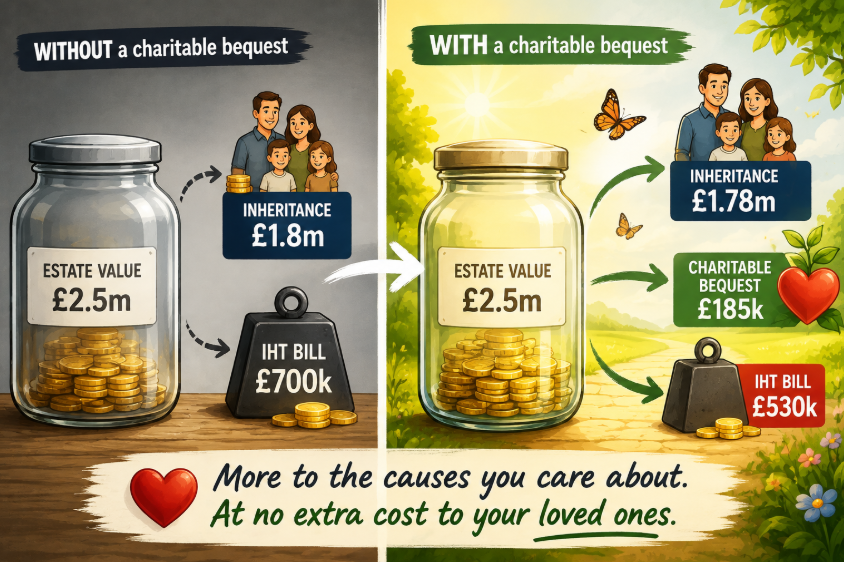
(image created by AI; article written by me)
By George Taylor, CFA
When philanthropy meets tax efficiency
A carefully structured charitable bequest can deliver up to three separate inheritance tax benefits: the gift itself is IHT-exempt, the rate on the remaining estate can fall from 40% to 36%, and it can restore a tapered Residence Nil-Rate Band. In the right circumstances, giving £185,000 to charity can cost your children as little as £7,550 each.
When we talk about estate planning — principally, ways to reduce or provide for a potential Inheritance Tax (IHT) bill — we normally come back to the ‘big three’:
Gift it — give assets away during your lifetime, either directly or via trust;
Invest it — invest into qualifying Business Relief assets, which are potentially exempt from IHT after two years; or
Insure it — take out a Whole of Life insurance policy, written in trust, to provide your beneficiaries with a lump sum towards some or all of the eventual IHT bill.
We’ll be revisiting these in an upcoming blog.
This week, however, I want to focus on a fourth option: leave it to charity.
More specifically, leaving a meaningful legacy in your Will to a qualifying charity — or charities — close to your heart.
Clearly, the primary motivation here should be philanthropic. But charitable bequests also happen to be highly tax-efficient. In the right circumstances, you can leave a substantial sum to charity while reducing what your family ultimately inherits by surprisingly little.
Put another way, a significant proportion of your charitable gift can effectively be funded by HMRC, through the IHT you no longer have to pay.
How it works
Most people understandably assume that leaving money to charity in their Will means leaving significantly less to their family.
For estates subject to IHT, however, the maths can be much more favourable than you might expect.
A carefully structured charitable bequest can cost your beneficiaries remarkably little because some — and potentially most — of the gift is effectively met by a reduction in the IHT bill that would otherwise have been payable.
Charitable bequests: a double tax saving
There are two distinct IHT advantages to leaving money to charity. It is the combination of the two that makes this particularly powerful.
1. Charitable gifts are exempt from IHT
Anything left to a qualifying charity is generally outside the charge to IHT. So, unlike money left to your children or other beneficiaries, the charitable legacy itself does not suffer inheritance tax.
2. Reduced IHT rate on the rest of your estate
Second, leave enough to charity and the IHT rate on the rest of your estate can fall from 40% to 36%.
Broadly, if you leave at least 10% of the relevant ‘baseline amount’ of your estate to charity, the reduced 36% IHT rate can apply to the remainder of the taxable estate. That 4 percentage-point reduction might not sound enormous, but on a sizeable estate it can make a very meaningful difference.
This is why the economics can be so counterintuitive: you can give a meaningful amount to charity without reducing your family's inheritance by anything like the same amount.
The calculation of the 10% test is slightly fiddly. In simple terms, it is based on the estate after deducting certain exemptions, reliefs and the available standard Nil-Rate Band — currently up to £325,000 per person. Importantly, the Residence Nil-Rate Band is not deducted when calculating the 10% charitable giving test. This is best illustrated with an example — which we'll come to shortly.
And potentially a third saving...
There can also be another useful interaction for larger estates.
The Residence Nil-Rate Band (RNRB) begins to taper away where an estate exceeds £2 million. A charitable bequest reduces the value of the estate used for this test and can therefore, in some circumstances, restore some or all of a Residence Nil-Rate Band that would otherwise have been lost.
So, depending on the estate, a charitable legacy can potentially deliver three separate IHT benefits:
The charitable gift itself is exempt from IHT;
The IHT rate on the remaining taxable estate can fall from 40% to 36%; and
It can potentially preserve or restore some of the Residence Nil-Rate Band.
That combination can produce some surprisingly powerful results.
Let's look at some examples.
Example 1: Double tax saving
Jack and Kate are married, with a combined estate worth £2 million, including their main residence, valued at £600,000. Their Wills currently leave everything to their two children, with no provision for charity.
Their IHT position looks like this:
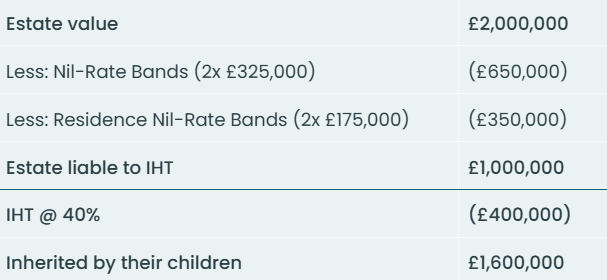
So, without any further planning, Jack and Kate's estate faces an IHT bill of £400,000, leaving £1.6 million to their children — £800,000 each.
Now let's introduce a charitable bequest
Jack and Kate decide that they would like to leave enough to charity to qualify for the reduced 36% IHT rate.
Broadly, to do this, they need to leave at least 10% of their estate's ‘baseline amount’ to charity.
Estate value: £2,000,000
Less Nil-Rate Bands: £650,000
Baseline amount: £1,350,000
10% charitable bequest: £135,000
They therefore amend their Wills to leave £135,000 to charity.
As a side note here, it can be sensible to express this as a percentage or formula within the Will, rather than specifying a fixed monetary amount. Otherwise, changes in the value of the estate could inadvertently leave the charitable gift just short of the 10% threshold, in which case the standard 40% IHT charge would still apply.
Their revised IHT position is:
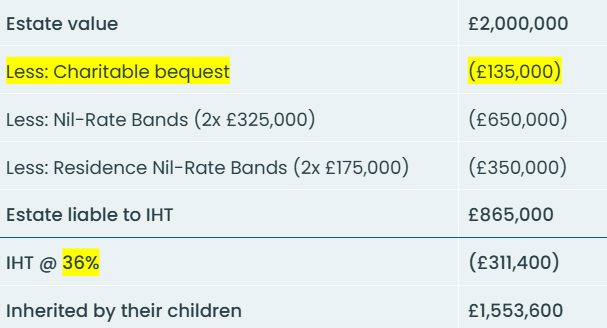
This is where the maths becomes compelling.
Jack and Kate have given £135,000 to charity, but their children's inheritance has fallen by just £46,400 — or £23,200 each.
Why? Because the charitable bequest produces the ‘double whammy’ tax saving described earlier:
the £135,000 charitable gift is itself exempt from IHT; and
because the gift meets the 10% test, the IHT rate on the remaining taxable estate falls from 40% to 36%.
As a result, their IHT bill falls from £400,000 to £311,400 — a saving of £88,600.
Put another way:
£135,000 goes to charity.
HMRC receives £88,600 less.
Their children receive just £46,400 less.
So, of Jack and Kate's £135,000 charitable legacy, almost two-thirds is effectively funded through the reduction in IHT, with only around one-third coming at the expense of their children's inheritance.
Example 2: Give more to charity and leave more to your children
The maths becomes even more compelling where someone already intends to leave money to charity, but their planned bequest falls just short of the 10% threshold.
Returning to Jack and Kate, suppose their Wills already provide for £100,000 to be divided between four charities — £25,000 each.
Their IHT position would look like this:
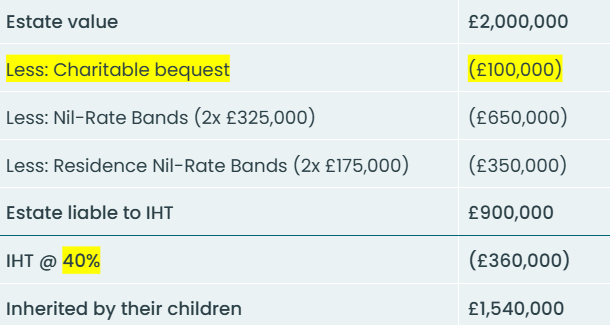
The ‘problem’ is that their £100,000 charitable bequest falls short of the £135,000 required to meet the 10% test. The remaining taxable estate therefore continues to suffer IHT at 40%.
The £100,000 gift still saves £40,000 of IHT, but their children's inheritance falls by £60,000. In effect, 40% of the charitable gift is funded through lower IHT, with the remaining 60% coming from the children's inheritance.
But now consider what happens if Jack and Kate increase their charitable bequest from £100,000 to £135,000.
As we saw in Example 1, this takes them over the 10% threshold and reduces the IHT rate on the remaining taxable estate from 40% to 36%.
The result is rather counterintuitive:
Charities receive £35,000 more — increasing from £100,000 to £135,000;
IHT falls by £48,600 — from £360,000 to £311,400; and
Their children inherit £13,600 more — increasing from £1,540,000 to £1,553,600.
In other words, Jack and Kate can give an additional £35,000 to charity and, at the same time, leave an additional £13,600 to their children.
It is worth stressing that the objective here isn't simply to deprive HMRC of tax. Inheritance Tax is a legitimate part of the tax system, and charitable giving should ultimately be driven by a genuine desire to support causes that matter to you. But where a sizeable IHT bill is likely to arise anyway, it is entirely reasonable to consider where you would prefer some of that money to go. The charitable reliefs deliberately built into the IHT system give you that choice.
Example 3: Restoring the RNRB
As noted earlier, there is potentially a third tax benefit to charitable giving: a charitable bequest can help restore Residence Nil-Rate Band (RNRB) that would otherwise be lost.
As a reminder, the RNRB begins to taper away once an estate exceeds £2 million, at a rate of £1 of allowance for every £2 by which the estate exceeds that threshold.
This is particularly relevant ahead of the new rules taking effect from 6 April 2027, when most unused pension funds will be brought within the scope of IHT. For some families, including pension wealth within the estate will push them above the £2 million threshold for the first time.
And the effect can be painful. While the RNRB is being tapered away, each additional £1 of estate can both be subject to IHT and cause 50p of tax-free allowance to be lost. For an estate that is otherwise entitled to the RNRB, this can create an effective 60% marginal IHT rate while the allowance is being tapered away.
Revisiting the previous example, in addition to their £2 million estate, suppose Jack and Kate have £500,000 of pension savings between them.
Once those pensions are brought within the scope of IHT, their estate for these purposes increases to £2.5 million.
Assuming no charitable provision, their position would look like this:
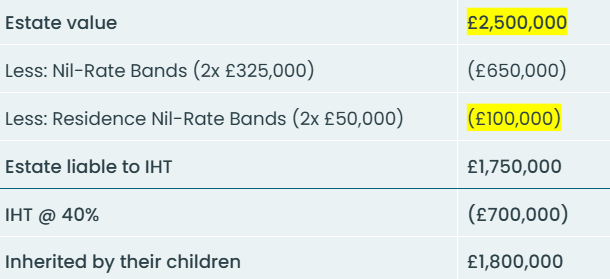
As you can see, their RNRB entitlement has fallen from £350,000 to just £100,000. That’s because their estate is now £500,000 above the £2 million threshold. The RNRB is therefore reduced by half of that excess — £250,000 — taking their combined allowance from £350,000 to £100,000.
The effect is significant. Their estate has increased by £500,000, but their IHT bill has increased from £400,000 to £700,000 — an increase of £300,000.
So, of that additional £500,000 of wealth, 60% is absorbed by additional IHT, leaving their children with ‘only’ £200,000 of the increase.
Now introduce a charitable bequest.
This is where charitable giving becomes most powerful, because it can potentially deliver all three tax benefits at once.
Jack and Kate's baseline amount for the reduced-rate charitable giving test is:
Estate value: £2,500,000
Less Nil-Rate Bands: £650,000
Baseline amount: £1,850,000
10% charitable bequest: £185,000
They therefore amend their Wills to leave £185,000 to qualifying charities.
Their revised position looks like this:
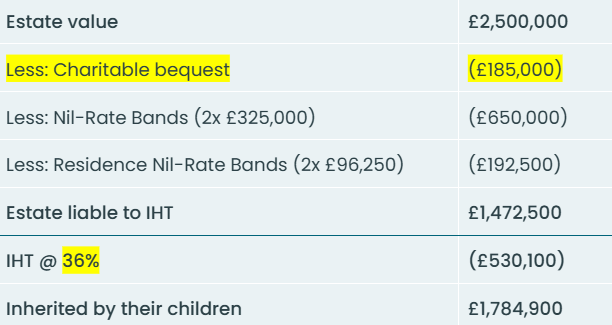
There are now three separate tax benefits working together.
First, the £185,000 charitable bequest itself is exempt from IHT.
Second, because the gift meets the 10% test, the IHT rate applying to the remaining taxable estate falls from 40% to 36%.
And third, the charitable bequest reduces the estate used to calculate the RNRB taper.
Instead of an estate of £2.5 million for taper purposes, the charitable gift brings this down to £2.315 million. The excess above the £2 million threshold therefore falls from £500,000 to £315,000.
As a result, their combined RNRB increases from £100,000 to £192,500 — effectively restoring another £92,500 of tax-free allowance.
The overall impact is striking:
£185,000 goes to charity
IHT falls by £169,900, from £700,000 to £530,100
The children's inheritance falls by just £15,100, from £1,800,000 to £1,784,900
Put another way, Jack and Kate can redirect £185,000 to charitable causes, while their two children receive just £7,550 less each.
Around 92% of the charitable bequest is effectively funded by the reduction in IHT, with only 8% coming at the expense of their children's inheritance.
That illustrates just how significant the interaction between these reliefs can be.
And this interaction is likely to become much more relevant from April 2027. Bringing pensions within the scope of IHT will not simply increase the number of estates facing an IHT bill; it will also push more estates above the £2 million RNRB taper threshold.
For those families — particularly those already minded to leave something to charity — charitable bequests will likely become a much more prominent part of the estate-planning conversation.
If you have any questions, or would like us to crunch the numbers on your own estate to see how a charitable bequest might work in practice, please get in touch.
Happy Thursday.
Kind regards,
George
Referrals Welcome
Our business grows mainly through personal recommendations. If you know someone—whether a friend, family member or colleague—who might benefit from financial planning, we’d be grateful if you could share my details with them. Alternatively, you can pass their details on to me, and I’ll be happy to reach out.
Regulatory Information
Blincoe Financial Planning Limited is an appointed representative of Sense Network Ltd, which is authorised and regulated by the Financial Conduct Authority. Registered in England & Wales (No. 14569306). Registered Office: Star Lodge, Montpellier Drive, Cheltenham, GL50 1TY.
Important Disclaimer
This blog is for general information only and is intended for retail clients. It does not constitute financial or tax advice, nor is it an offer to buy or sell any specific investment. Since I don’t know your personal financial situation, you should not rely on this content as tailored advice. While we aim to provide accurate and up-to-date information, we cannot guarantee that all details remain correct over time. We are not responsible for any losses resulting from actions taken based on this blog’s content.
Start here
Wondering if we'd be a good fit?
Answer a few short questions about your situation. If it looks like we can help, you can book an introductory call with one of our planners at the end.
See if we're a good fitTwo minutes. No obligation.