
Lump Sum vs Phased Investing: What the Evidence Says and the Approach We Most Often Recommend

(image created by AI; article written by me)
By George Taylor, CFA
How quickly should you invest?
Lump-sum investing beats phased investing around two-thirds of the time historically, yet committing a large sum all at once and watching markets fall immediately is one of the most common triggers for poor investor decisions. This blog weighs the evidence, explains a structured 50-60% upfront approach with dynamic phasing, and makes the case for rules over instinct.
To phase, or not to phase…
One of the more consequential decisions you will make as an investor is also one of the least discussed: having decided what to invest in, how should you actually put a large sum of money to work?
The question arises whenever a significant amount of capital arrives in one go — perhaps from the sale of a business, an inheritance, a property downsize, or simply the accumulation of surplus cash.
The investment structure may already be settled — pensions, ISAs, investment accounts and so on — and the underlying portfolio agreed. But one question remains: do you invest the money all at once, or gradually over time?
There are two broad approaches. You can invest the full amount immediately — lump-sum investing — or drip-feed it into the market over a period of time — phased investing.
This week’s blog looks at what the evidence tells us about each, explains the approach I most often recommend, and explores the trade-offs involved.
When investing, your capital is at risk. The value of your investment can go down as well as up, and you may get back less than you invested, particularly when investing for a short timeframe. Past performance is not a reliable indicator of future performance. Investments should be considered over the longer term and should fit in with your overall attitude to risk and financial circumstances.
The evidence favours lump-sum investing
On average, investing the whole amount straight away produces the better financial outcome.
The reason is straightforward: over the long run, markets rise more often than they fall.
Based on data from the Federal Reserve Economic Data (FRED) database spanning more than 150 years of US equity market history, the probability of a positive return over any one-month period has been around 57%. Extend the timeframe to one year and that rises to around 70% (i.e. roughly two years in three).
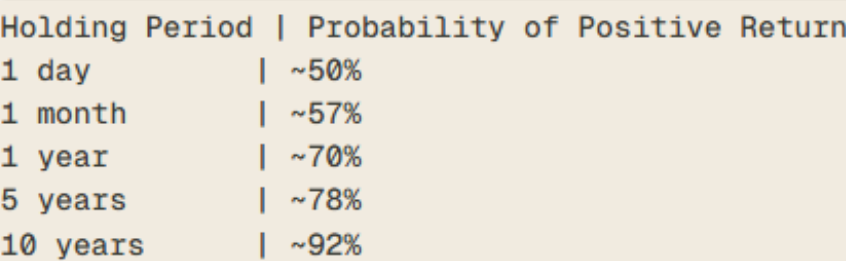
Source: FRED via Pomegra Learn
Money that is invested benefits from this upward tendency; money held back in cash, waiting for a more comfortable entry point, does not.
This explains why the major studies on the subject reach broadly the same conclusion: historically, investing a lump sum immediately has finished ahead of gradually drip-feeding the same amount into the market around two-thirds of the time.
As the old adage goes, time in the market, rather than timing the market, tends to do most of the heavy lifting.
If maximising expected returns were the only consideration, the article could probably end here.
It isn't.
But the average is not the whole story
Despite the evidence above, when investing a significant lump sum, we often lean towards phasing the money into the market over time.
The rationale is not primarily statistical. It is emotional.
You may have spent decades building up this capital. Investing it all on Monday and then watching markets fall sharply on Tuesday — simply through bad luck (or a rogue Tweet from the US President) — can be an extremely uncomfortable experience.
And markets have an unfortunate habit of falling much faster than they rise.
Gains tend to accumulate gradually, across long stretches of relatively unremarkable days. Losses, by contrast, can arrive suddenly and violently, concentrated into short and memorable episodes. I often describe this to clients as markets going “up the escalator and down the lift shaft”.
This asymmetry matters.
The potential cost of phasing is usually fairly mundane: while some of your money remains in cash, markets may continue to grind higher and you miss out on some of that return.
Meanwhile, the potential benefit can be much more dramatic: if markets fall sharply shortly after you begin investing, you still have capital waiting on the sidelines that can be invested at lower prices.
More importantly, phasing can reduce the risk of what we refer to as “the big mistake” — selling out after a major market decline.
Consider an investor who committed a substantial lump sum in October 2007, shortly before the Global Financial Crisis, or in the late summer of 1987, shortly before Black Monday. In both cases, investing immediately was perfectly consistent with the historical evidence. Unfortunately, both investors would then have watched their newly invested capital suffer an exceptionally sharp decline.
The crucial question is not simply whether those investments eventually recovered. They did. It is whether the investor could remain invested long enough to experience that recovery.
Of course, phasing into a decline would still have been uncomfortable. But with some capital remaining in cash, subsequent investments could have been made at progressively lower prices, reducing the average purchase price and softening the impact of the downturn across the portfolio as a whole.
Perhaps more importantly, this may have made it a little easier to stay the course — and reduced the temptation to make the “big mistake” of selling after a significant fall.
A structured middle ground
The approach I most often recommend is designed to capture much of the benefit of investing early, while reducing the risk of an unfortunate entry point. It has three components.
First, invest 50–60% of the money immediately. This provides meaningful market exposure from day one, recognising that the odds favour being invested. If markets continue to rise — historically the more common outcome — the majority of your capital is already participating.
Second, phase the remaining balance into the market in regular instalments, typically over twelve to eighteen months. This spreads your entry point over time and reduces the importance of market conditions on any single day.
Third — and this is what distinguishes the approach — make the phasing dynamic rather than purely mechanical. For every 5% the market falls from its most recent high-water mark, one of the later scheduled instalments is brought forward and invested.
We like this middle ground. It deliberately leans towards investing more at the outset, reflecting the long-term upward tendency of markets, while keeping some dry powder available should markets suffer a short, sharp setback.
The dynamic element is important too. Rather than simply continuing to invest according to the calendar, market falls accelerate the process. In effect, short-term weakness becomes an opportunity to put more capital to work at lower prices.
Rules-based, not market timing
There is, however, an important principle underpinning all of this: any phasing strategy should be rules-based.
At the outset, we agree how much will be invested immediately, how long the remaining investment will be phased over, and the circumstances in which that timetable will be accelerated. Those decisions are made in advance.
What we want to avoid is repeatedly asking whether now “feels” like a good time to invest.
In reality, there will always be something to worry about. Indeed, markets have an awkward tendency to feel safest after they have risen and most frightening after they have fallen — precisely the opposite of what would be helpful when deciding when to invest.
Nor should we assume that professional investors can reliably solve this problem for us. Forecasting short-term market movements is notoriously difficult, and even professional economists and investment strategists have a poor record of predicting where markets will be a year from now.
The answer, in our view, is to set the rules in advance, then follow them.
Understanding the trade-off
The evidence would suggest that on average, phasing is likely to produce a slightly lower return than investing immediately, because some of your capital remains in cash while markets tend to rise.
By phasing, however, you reduce the risk of committing the entire sum immediately before a significant market fall. Should markets decline, you still have capital available to invest at lower prices.
There is no suggestion that this approach can predict or beat the market. It simply accepts a small expected cost in exchange for reducing the importance of a single entry point — and, potentially, making it easier to remain disciplined if markets fall shortly after investing.
Summary
For an investor placing a large sum, the choice is rarely as simple as the averages suggest.
Investing all at once is, on balance, the higher-returning course, and for those comfortable with the possibility of an immediate fall it remains entirely defensible.
For many, however, a structured approach — 50-60% invested at once, the balance phased in over twelve to eighteen months, with a rule that leans into market falls — offers a sensible compromise between capturing the long-run tendency of markets to rise and managing the risk, and the anxiety, of an unlucky start.
If you would like to consider how this might apply to your own circumstances, I would be glad to discuss it.
Happy Thursday.
Kind regards,
George
Referrals Welcome
Our business grows mainly through personal recommendations. If you know someone—whether a friend, family member or colleague—who might benefit from financial planning, we’d be grateful if you could share my details with them. Alternatively, you can pass their details on to me, and I’ll be happy to reach out.
Regulatory Information
Blincoe Financial Planning Limited is an appointed representative of Sense Network Ltd, which is authorised and regulated by the Financial Conduct Authority. Registered in England & Wales (No. 14569306). Registered Office: Star Lodge, Montpellier Drive, Cheltenham, GL50 1TY.
Important Disclaimer
This blog is for general information only and is intended for retail clients. It does not constitute financial or tax advice, nor is it an offer to buy or sell any specific investment. Since I don’t know your personal financial situation, you should not rely on this content as tailored advice. While we aim to provide accurate and up-to-date information, we cannot guarantee that all details remain correct over time. We are not responsible for any losses resulting from actions taken based on this blog’s content.
Start here
Wondering if we'd be a good fit?
Answer a few short questions about your situation. If it looks like we can help, you can book an introductory call with one of our planners at the end.
See if we're a good fitTwo minutes. No obligation.