
ISA Rule Changes 2027 and 2028 Explained: What the New Cash Limits, LISA Overhaul, and 22% Charge Mean for You
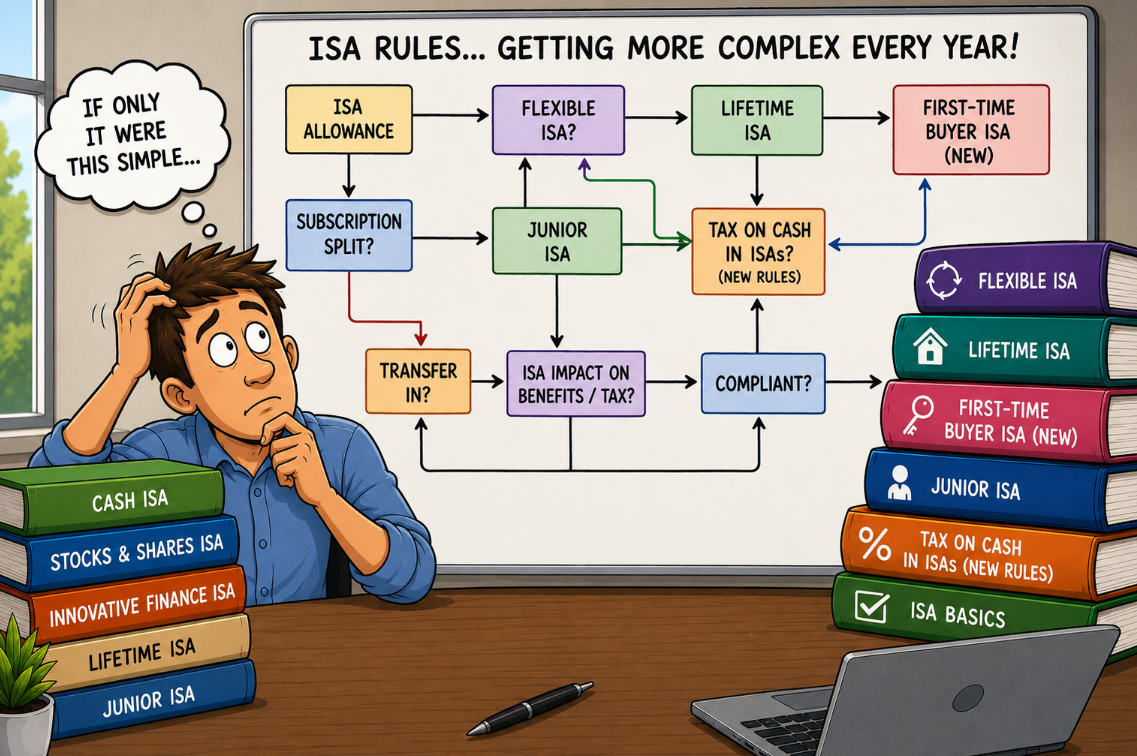
(image created by AI; article written by me)
By George Taylor, CFA
What you need to know before April 2027
Major ISA rule changes are coming: from April 2027, under-65s face a reduced £12,000 Cash ISA allowance and a 22% tax charge on uninvested cash in Stocks and Shares ISAs, while the Lifetime ISA is being scrapped and replaced by a First-Time Buyer ISA in April 2028. In this week’s blog, we explore the practical implications of both changes, the available workarounds, and our view on what the government should do instead.
ISAs have long been a stalwart of the UK savings and investment world, and their main appeal is simplicity. You can invest up to £20,000 a year from post-tax income, and then any income or gains within the ISA ‘wrapper’ are completely tax-free. There are no restrictions on withdrawals (aside from Lifetime ISAs, which we'll cover shortly).
Over recent years, however, that simplicity has been eroded by an expanding menu of ISA types. Under the current regime, there are now five main variants:
Cash ISAs — available to any UK resident adult. Deposit up to £20k annually and hold it in cash, whether as easy access, fixed-term, or limited-access accounts.
Stocks & Shares ISAs — the same annual allowance, but invested in equities, bonds, commodities, funds, or other investments.
Junior ISAs — for under-18s, offered as either cash or stocks & shares. The annual allowance is £9,000. Funds cannot be accessed until age 18, at which point the account automatically converts to an adult ISA, giving the young adult unrestricted access.
Innovative Finance ISAs — for peer-to-peer lending investments. Rarely used.
Lifetime ISAs — a special wrapper for those aged 18–40 (you must open one before turning 40, though contributions can continue until age 50). You can invest up to £4,000 annually (part of your overall £20k total allowance) and receive a 25% government bonus, credited within 6–10 weeks. The catch: funds are restricted to either a first home purchase (up to £450,000) or retirement at 60+. Withdrawals for other purposes incur a 25% charge—effectively clawing back the bonus plus a 6.25% penalty—a feature that has attracted considerable criticism.
When investing, your capital is at risk. The value of your investment can go down as well as up, and you may get back less than you invested. Past performance is not a reliable indicator of future performance. Investments should be considered over the longer term and should fit in with your overall attitude to risk and financial circumstances.
1. The New Rules on Cash in ISAs
From April 2027, the rules around cash held in ISAs are changing significantly, particularly for those under 65.
The headline change
For under-65s, the Cash ISA allowance drops from £20,000 to £12,000 per year. The remaining £8,000 of your total £20,000 allowance must go into a Stocks and Shares ISA if you want to use it in full.
Four specific new rules
A 22% flat charge will apply to interest earned on uninvested cash held within a Stocks and Shares ISA—regardless of your tax band. This applies to all savers, not just under-65s. According to The Investors Centre, around £511 billion is held in UK Stocks & Shares ISAs. Assuming a conservative 2% average allocation to cash (I suspect the real figure is higher), that implies cash holdings of roughly £10 billion. A 22% charge on say 4% interest could reasonably raise c. £90 million annually for HMRC - sadly, a ‘rounding error’ in the context of current spending.
You cannot hold 100% of a Stocks and Shares ISA in "cash substitutes" such as Money Market funds. At least some genuine investment holdings (at least 1%) must sit within the account. Money Market funds are popular because they offer very low-risk returns by investing in short-term debt issued by governments and corporations, but under the new rules, this won't be a complete alternative to a Cash ISA.
Under-65s cannot transfer money from a Stocks and Shares ISA back into a Cash ISA. Once cash goes into stocks and shares, it stays there.
Over-65s retain their full £20,000 Cash ISA allowance and can still transfer freely between Stocks and Shares and Cash ISAs.
Implications by age group:
If you're over 65, only the 22% charge on cash interest affects you. You keep unrestricted access to your Cash ISA allowance and the flexibility to move between account types.
If you're under 65, the changes are more restrictive. The lower cash allowance and the prohibition on transferring back to cash create real planning constraints.
The practical workaround:
For under-65s seeking cash-like returns without the 22% charge, Money Market funds inside a Stocks and Shares ISA remain a viable option—but with an important caveat. You can hold up to 99% in a Money Market fund provided at least 1% sits in a genuine equity holding. This technically complies with the rules whilst keeping the vast majority of your money at cash-like risk. The interest won't be materially different from a pure Money Market fund, but you'll avoid the punitive 22% charge.
Our approach and concerns:
For most of our clients, these changes will have minimal practical impact. We typically maintain very low cash holdings—usually no more than 1% of portfolio value, primarily for operational needs such as fee payments. Most of our clients are fully or near-fully invested in their Stocks and Shares ISAs and aren't seeking to hold significant cash within them.
For the minority of clients with genuine near-term liquidity needs (such as a property purchase), we currently use Money Market funds as a cash substitute within their Stocks and Shares ISAs where appropriate. From April 2027, we'll simply need to ensure that at least 1% of the account remains in a genuine investment holding—a minimal adjustment to our current practice.
Our broader concern lies elsewhere. The added administrative burden on platforms—levying a 22% charge on cash holdings within Stocks & Shares ISAs, blocking transfers to Cash ISAs for under-65s, and managing two different contribution limits—could push providers to increase fees. Fee compression has been one of the most positive developments in recent years, driven by fierce competition. These new rules may reverse that welcome trend. We’ll see how that plays out.
2. Lifetime ISAs: Change is Coming
In last year's budget, former Chancellor, Rachel Reeves, announced that a replacement for Lifetime ISAs was coming. More details of the changes were announced on Tuesday, 23rd June 2026.
The current LISA is being retired to make way for a successor: the First-Time Buyer ISA, which is slated for an April 2028 debut.
Here are the key takeaways:
What stays the same for current holders:
If you already hold a LISA, the initial proposals suggest that you'll be able to continue contributing indefinitely under the original age restrictions (contributions accepted until age 50)—even after the new product launches.
What improves in the new product:
Under the new First-Time Buyer ISA, the 25% withdrawal charge will disappear. Currently, withdrawing for anything other than a first home purchase or retirement at 60+ costs you 25% of the withdrawal—a punitive charge made worse by the fact that the £450,000 property threshold has remained frozen for nearly a decade, rendering it increasingly disconnected from real house prices.
Furthermore, the new product will have no upper age limit for opening, compared with the LISA's 40-year cut-off. This is a genuine improvement for older first-time buyers who've been locked out.
What's likely to get worse:
The bonus structure is changing fundamentally.
The current LISA delivers a monthly 25% top-up that compounds alongside your own savings over time. The new product will pay the 25% as a lump sum only when you complete on a home purchase. This sounds simpler, but it means you potentially lose years of compounding on the bonus itself—likely resulting in a lower final pot.
You won't be able to transfer an existing LISA into the new product; the government bonus can't be claimed twice. However, you can use funds from both towards the same purchase, but the accounts must remain separate.
A significant concern for us:
As the name suggests, the new product is for first-time buyers only, closing a planning opportunity: using a LISA to bolster retirement savings.
We use this strategy for many clients, particularly those limited by the tapered annual allowance on pension contributions—anyone earning above £360,000, for example, can only contribute £10,000 gross to a pension and receive tax relief. A LISA with its monthly bonus has been a valuable workaround. The new product removes this option entirely.
Why you should consider opening a LISA now:
If you're eligible (aged 18–39) and haven't already opened one, there's a strong case to do so now—even with a token £10 contribution.
We don't yet know the new product's bonus rate, contribution limit, or property cap—they're all still being consulted on. But we do know the current LISA rules remain unchanged for existing holders. Opening one now locks in these (likely) better terms for as long as you contribute, and it costs nothing if your circumstances change.
Our View on the New Rules
For what it’s worth, we support the government's intent: encouraging investment over cash would genuinely benefit individual savers and the wider economy (and ultimately, reduce reliance on the state). But we don't think adding complexity to an already increasingly complex ISA system is the answer.
For one, the vast majority of ISA wealth is held by the over-65s, so the impact of reduced cash allowances for under-65s will be limited. More importantly, if the goal is to build a more investment-minded Britain, allowance tinkering isn't the right lever in our view. Better options exist, such as:
financial education so people understand what cash costs them over time (i.e. how inflation likely erodes the real purchasing power),
deregulation to make investing cheaper and easier, and
removing friction costs like stamp duty on UK share purchases.
One ISA to Rule Them All
We'd rather see the government simplify the ISA system rather than adding additional layers of rules to an already fragmented product range.
AJ Bell, for example, has long advocated for a single unified ISA:
One product that holds both cash and investments. Combine Cash ISAs and Stocks and Shares ISAs, removing the artificial divide between "saving" and "investing" that confuses many savers and eliminates the need to juggle transfer rules between account types.
Age-banded limits instead of a separate Junior ISA. A £9,000 annual limit for under-18s, rising to £20,000 from 18 onwards, all within the same account structure. This mirrors the current JISA limit but avoids the need for a separate conversion at age 18.
A house-purchase bonus built into the main product. Rather than a separate Lifetime ISA or First-Time Buyer ISA, include a 25% bonus on annual contributions (capped at say £1,000 a year) paid to the buyer's conveyancing solicitor on completion. This maintains the incentive to save for a first home without creating a separate product with its own rules and penalties.
Scrap the Innovative Finance ISA. It's barely used and adds unnecessary complexity to an already fragmented system.
In Summary
The April 2027 cash ISA changes and April 2028 LISA overhaul will add complexity to an already fragmented ISA system. Under-65s face tighter cash allowances, and a new 22% charge on uninvested cash will affect all Stocks and Shares ISA investors—though holding 99% in Money Market funds with 1% in genuine investments remains a viable workaround.
Existing LISA holders are said to be protected under current proposals, and if you're eligible but haven't opened one, there's a strong case to do so now to lock in the current (likely preferential) rules.
We support the government's aim to encourage more investment, but allowance tinkering isn't the answer in our view. A simpler, unified ISA system would serve savers far better than continued piecemeal changes.
Happy Thursday.
Kind regards,
George
Referrals Welcome
Our business grows mainly through personal recommendations. If you know someone—whether a friend, family member or colleague—who might benefit from financial planning, we’d be grateful if you could share my details with them. Alternatively, you can pass their details on to me, and I’ll be happy to reach out.
Regulatory Information
Blincoe Financial Planning Limited is an appointed representative of Sense Network Ltd, which is authorised and regulated by the Financial Conduct Authority. Registered in England & Wales (No. 14569306). Registered Office: Star Lodge, Montpellier Drive, Cheltenham, GL50 1TY.
Important Disclaimer
This blog is for general information only and is intended for retail clients. It does not constitute financial or tax advice, nor is it an offer to buy or sell any specific investment. Since I don’t know your personal financial situation, you should not rely on this content as tailored advice. While we aim to provide accurate and up-to-date information, we cannot guarantee that all details remain correct over time. We are not responsible for any losses resulting from actions taken based on this blog’s content.
Start here
Wondering if we'd be a good fit?
Answer a few short questions about your situation. If it looks like we can help, you can book an introductory call with one of our planners at the end.
See if we're a good fitTwo minutes. No obligation.