
The 37% Tax Rate Most Graduates Don't Know They're Paying - and What Parents Can Do About It

(image created by AI; article written by me)
By George Taylor, CFA
Published: 10/09/2026
A graduate leaving university with £50,000 of student debt on a £40,000 salary will see their loan balance grow in year one, despite making repayments — because interest compounds faster than the mandatory 9% repayment. This week’s blog explains how student loan compounding works, who pays the most, and how parents can flip compounding in their favour with around £160 a month.
"Compound interest is the eighth wonder of the world. He who understands it, earns it… he who doesn't… pays it" [attributed to Albert Einstein].
Every September, a new cohort of graduates enters the workforce carrying a rather unusual form of debt.
Unlike a mortgage or personal loan, student debt isn't necessarily something you will ever repay in full. For many graduates, it will simply sit in the background for decades, taking a slice of earnings along the way, before whatever remains is eventually written off.
Student debt is a topic that is coming up increasingly often in client conversations. Sometimes the question is from recent graduates themselves wondering whether they should repay their own loan early. Increasingly, though, it is from parents and grandparents asking a different question:
Could we plan ahead so that our children never need to take on the debt in the first place?
This is where compounding gets interesting. For graduates with large student loans, compounding can work against them. For parents who start planning early enough, exactly the same force can be made to work for them.
How the Current Student Loan System Works
Undergraduate students starting university courses in England from August 2023 onwards generally fall under Plan 5.
The key terms are:
Repayments are 9% of earnings above £25,000 a year.
Interest is charged at RPI (currently set at 4.1% for the year to August 2027).
Any remaining balance is written off 40 years after repayments become due.
Older loans work slightly differently. For example, Plan 2 loans apply to students who started between 2012 and 2023 and attract higher rates of interest (up to RPI + 3%), although the write-off period is shorter at 30 years.
According to the Student Loans Company, average graduate debt now exceeds £50,000. That broadly matches what we tend to see among younger clients coming through our own doors.
And £50,000 is where the maths starts to become interesting (nay terrifying).
The 9% ‘Graduate Tax’
Student loan repayments aren't technically a tax, but for many graduates they behave like one.
Once earnings exceed the repayment threshold, another 9% is effectively deducted from the next pound earned, on top of Income Tax and National Insurance.
Under the current Plan 5 system, this gives rise to the following marginal tax rates (i.e. the ‘tax’ applied to every additional £1 earned):
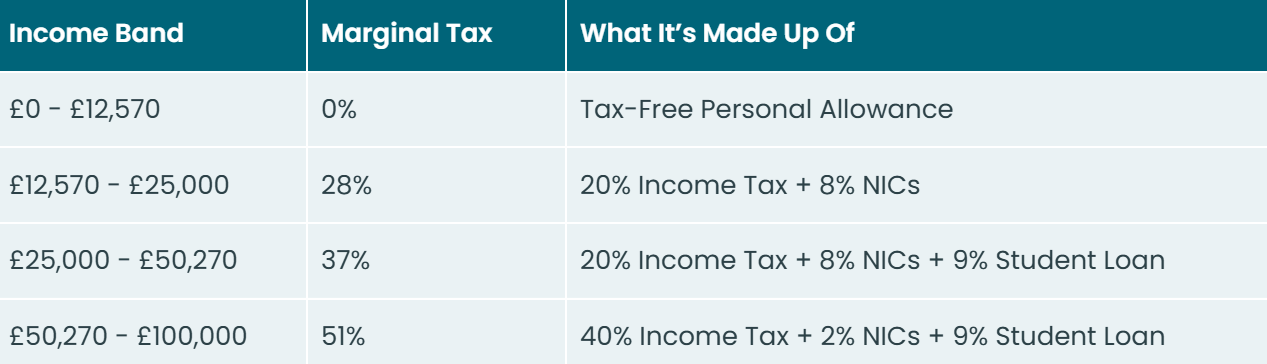
*NICs - Employee National Insurance Contributions
For example, a graduate earning £45,000 loses 37p of each additional £1 earned to Income Tax, National Insurance and student loan repayments - a significant drag on earnings.
If earnings climb above the (persistently frozen) higher rate tax threshold, they lose over half their additional earnings to tax, NICs and student loan repayments.
When Compounding Works Against You
This is where student debt can look particularly galling.
Imagine a graduate leaves university with £50,000 of Plan 5 student loan debt and starts work on a salary of £40,000. These figures are broadly in line with average student debt (according to the Student Loans Company) and average graduate starting salaries (based on Government labour statistics).
At the current interest rate of 4.1% (RPI), roughly £2,050 of interest is added to the loan during the first year.
But their compulsory student loan repayment is only £1,350 (9% × (£40,000 - £25,000)).
They've paid £1,350 towards their student loan… yet the balance has actually increased by around £700.
That's compounding working against you.
The following year, interest isn't simply being charged on the original amount borrowed. It's being charged on the larger outstanding balance. More interest is added, which creates a larger balance, which creates more interest, and so on.
We’ve built a student loan calculator on our website (link here ) which lets you enter your current loan balance and projected earnings to see how much you might repay (and, importantly, how long it could take).
Extending our example above, if we assume 5% annual salary growth and RPI inflation averaging 4% a year, the £50,000 loan would eventually be cleared after around 22 years.
Total repayments? Around £84,750.
In other words, an original £50,000 debt results in almost £35,000 of additional repayments along the way.
Who Pays the Most?
This is one of the stranger features of the student loan system: the people who earn the most don't necessarily suffer the greatest overall cost.
Broadly speaking:
Lower earners repay relatively little and may eventually have much of the balance written off.
Very high earners make large repayments and clear the debt relatively quickly (limiting the amount of time interest has to compound).
It is typically those somewhere in the middle who get caught.
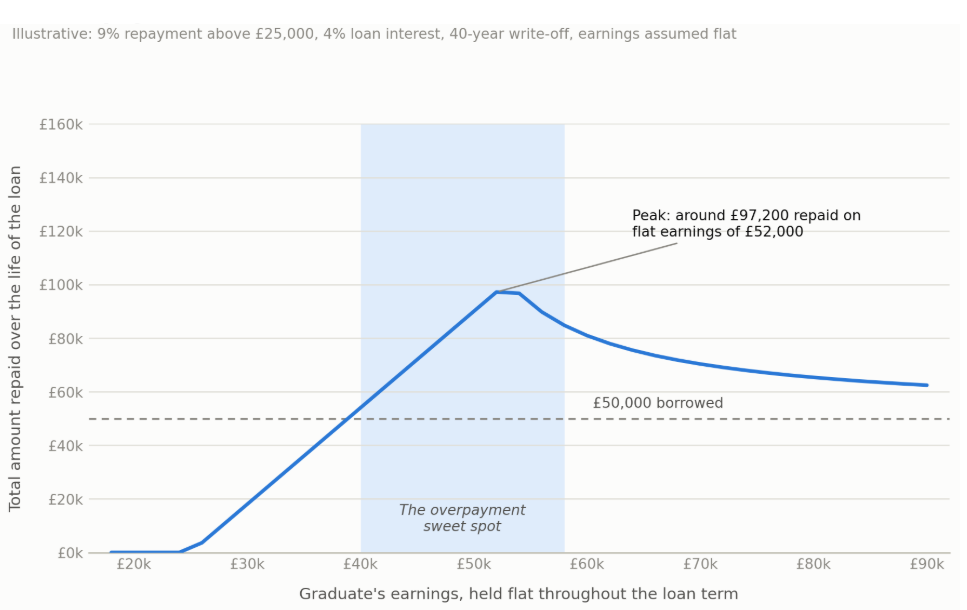
For someone earning around £45,000 to £55,000, repayments can be enough to keep servicing the loan for years, but not enough to kill it off quickly.
The debt can effectively “wash its face”. Repayments broadly keep pace with the interest, while the 9% deduction continues year after year.
This dynamic is illustrated in the chart below, which compares the total amount repaid over the lifetime of the loan, vs different earnings levels.
This naturally leads to another question we hear regularly:
“Should I just repay my student loan early?”
The answer (annoyingly) is: it depends.
If you're likely to remain in that middle-to-higher earning bracket for many years, there can be a strong mathematical case for repaying early and stopping the interest from compounding.
But future earnings matter enormously.
Someone earning £50,000 today might appear to be an obvious candidate for overpayment. But what if they plan to have children in a few years and take a career break? Or reduce their working week from five days to three, bringing earnings down to £30,000?
Suddenly, the maths changes.
It's also important to remember that student debt is very different from conventional borrowing. It doesn't appear on your credit file in the same way as a personal loan or credit card balance (although the repayments can affect mortgage affordability).
For someone trying to build a house deposit, for example, using £30,000 of savings to clear student debt rather than putting it towards a home might be the wrong decision.
As ever with financial planning, you can't really look at one part of the plan in isolation.
Flipping Compounding on Its Head
So far, we've looked at how compounding can work against a graduate.
Now let's flip it around.
One strategy we're increasingly building into clients' financial plans is a dedicated “university nest egg” for children or grandchildren.
The idea is simple: start early, contribute a relatively modest amount regularly, invest it for the long term and allow compounding to do the heavy lifting.
Returning to our previous £50,000 example, suppose a new parent decides they would like to have £50,000 available in today's money when their child reaches 18.
(And, of course, they may not go to university. In that case, you've simply created a useful pot for a house deposit, further education or some other future need.)
Assume the investments generate an average real return of 4% a year after inflation, and contributions rise with inflation over time.
The amount that needs to be set aside is approximately £160 per month. That's roughly £5 a day (or, these days, about the price of a coffee in London).
Over 18 years, the family contributes roughly £35,000 in today's money.
But the pot at the end is worth approximately £50,000.
The remaining £15,000 hasn't come from additional saving. It has come from investment growth and, crucially, growth on previous growth (i.e. compounding now working in your favour, not against).
When investing, your capital is at risk. The value of your investment can go down as well as up, and you may get back less than you invested. Neither simulated nor actual past performance is a reliable indicator of future performance. Investments should be considered over the longer term and should fit in with your overall attitude to risk and financial circumstances.
Same £50,000. Very Different Journey.
In our graduate example, borrowing £50,000 and allowing interest to compound resulted in total repayments of around £85,000.
Starting 18 years earlier and allowing investment returns to compound meant that approximately £35,000 of contributions could potentially build a £50,000 university fund.
Same university cost. Completely different direction of travel.
On one side, compounding is adding to the debt.
On the other, it's helping to fund the goal.
Of course, this isn't quite an apples-for-apples comparison. Investment returns aren't guaranteed, inflation will vary, student loan rules will undoubtedly change again, and nobody knows at birth whether their child will actually go to university.
But the broader lesson is that time is an extraordinarily valuable financial planning tool.
The earlier you start planning for a known (or even possible) future expense, the less of the heavy lifting you need to do yourself.
Summary
Student loans are a slightly unusual form of debt, and whether it makes sense to repay them early depends heavily on your earnings (both now and in the future). For some, overpaying can save tens of thousands of pounds; for others, it may mean repaying money that would ultimately have been written off.
For parents and grandparents, however, there is another way to look at the problem.
Start early enough and you can flip compounding on its head. Rather than interest quietly adding to a child's future debt, investment growth can quietly build the pot that helps them avoid it.
As our example shows, investing around £160 a month for 18 years could potentially turn roughly £35,000 of contributions into a £50,000 university fund (in today's money).
The numbers won't work exactly like this in practice, of course. Investment returns, inflation, university costs and student loan rules will all change. But the principle remains the same: the more time you give compounding, the less of the heavy lifting you have to do yourself.
Please note, tax treatment, student loan terms and inflation depend on individual circumstances and on government policy, both of which can change.
Happy Thursday.
Kind regards,
George
Referrals Welcome
Our business grows mainly through personal recommendations. If you know someone—whether a friend, family member or colleague—who might benefit from financial planning, we’d be grateful if you could share my details with them. Alternatively, you can pass their details on to me, and I’ll be happy to reach out.
Regulatory Information
Blincoe Financial Planning Limited is an appointed representative of Sense Network Ltd, which is authorised and regulated by the Financial Conduct Authority. Registered in England & Wales (No. 14569306). Registered Office: Star Lodge, Montpellier Drive, Cheltenham, GL50 1TY.
Important Disclaimer
This blog is for general information only and is intended for retail clients. It does not constitute financial or tax advice, nor is it an offer to buy or sell any specific investment. Since I don’t know your personal financial situation, you should not rely on this content as tailored advice. While we aim to provide accurate and up-to-date information, we cannot guarantee that all details remain correct over time. We are not responsible for any losses resulting from actions taken based on this blog’s content.
Start here
Wondering if we'd be a good fit?
Answer a few short questions about your situation. If it looks like we can help, you can book an introductory call with one of our planners at the end.
See if we're a good fitTwo minutes. No obligation.