
Rising Bond Yields and Stock Markets: What Higher Interest Rates Mean for Your Portfolio Right Now

(image created by AI; article written by me)
By George Taylor, CFA
Published: 19/09/2026
Storm in a Teacup (or Canary in the Coalmine)?
Rising bond yields create headwinds for equities through higher financing costs, reduced consumer spending power and lower valuation multiples - yet global equities remain near all-time highs. This blog sets out why, outlines two scenarios for what happens next, and explains seven practical steps we are taking to make financial plans more resilient without predicting the outcome.
“US borrowing costs hit their highest level since 2007 on Tuesday, as a global bond sell-off deepened following a renewed surge in oil prices…” [FT.com].
This week, the US 10-year Treasury yield breached 5% for the first time in nearly three years. And before the brief spike in 2023, you have to go back to the run-up to the Global Financial Crisis of 2007–09 to find yields at similar levels.
Unsurprisingly, this has brought the usual warnings of an imminent market correction back to the fore.
Perhaps those warnings will prove justified. Or perhaps this will turn out to be another ‘storm in a teacup’ – another bout of market anxiety that ultimately passes without doing much lasting damage.
The problem is that nobody knows. Trying to predict whether a correction is coming, what will trigger it, how far markets might fall or when they will recover is notoriously difficult.
That doesn’t mean we should ignore what is happening either.
There is an important distinction between trying to predict markets and being market aware. We have no interest in making wholesale changes to portfolios based on a forecast that may or may not prove correct. Sudden lurches in investment strategy are rarely the way to build long-term wealth.
But we can recognise when the investment landscape is changing and ask whether there are sensible, measured adjustments that could make a financial plan more resilient.
When investing, your capital is at risk. The value of your investment can go down as well as up, and you may get back less than you invested, particularly when investing for a short timeframe. Past performance is not a reliable indicator of future performance. Investments should be considered over the longer term and should fit in with your overall attitude to risk and financial circumstances.
Why bonds matter to stockmarkets
Higher bond yields can create headwinds for equities through several channels:
Higher financing costs. Companies that rely on debt face higher borrowing costs. All else equal, that squeezes profit margins, reduces returns on capital and can make businesses more reluctant to invest.
Less money to spend elsewhere. Higher interest rates also affect households and governments. Consumers paying more to service mortgages and other debts have less disposable income to spend elsewhere. Governments face a similar problem: as the cost of servicing public debt rises, there is less room for spending elsewhere – particularly relevant given already-high levels of government borrowing.
Lower valuation multiples. There is also a more mechanical relationship. The value of a company ultimately reflects the future cash flows investors expect it to generate. When interest rates rise, those future cash flows are discounted at a higher rate, reducing what investors should theoretically be willing to pay for them today. In simple terms: higher rates tend to put downward pressure on equity valuations.
Despite all of this – and despite the recent move higher in bond yields – equities have proved remarkably resilient.
The chart below shows the five-year performance of the Fidelity Index World fund, which provides a reasonable proxy for the global stock market:
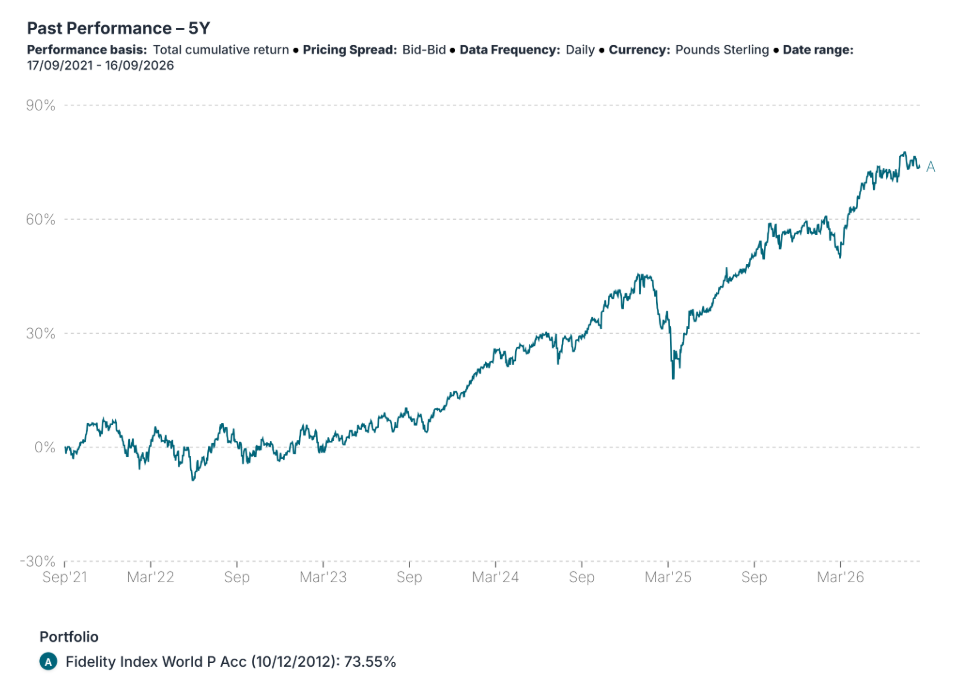
At the time of writing (16 September 2026), the fund sits just 2.7% below its recent all-time high. It is still up around 73.5% over five years, equivalent to roughly 11.6% a year.
So why have equities held up so well?
Why have equities proved so resilient?
There are three principal reasons, in my view.
Earnings growth has been exceptionally strong. Ultimately, share prices are underpinned by the profits companies generate. Earnings growth has remained robust, particularly in the US technology sector, where heavy investment in artificial intelligence – and expectations of the productivity gains it could deliver – has continued to support corporate profits and investor confidence.
Markets still expect inflation to moderate. Some of the recent inflationary pressure reflects higher energy and commodity prices. If those pressures subside – whether through increased supply, weaker demand, technological advances or an easing of geopolitical tensions – inflation could fall back. All else being equal, lower inflation should take some of the upward pressure off interest rates and bond yields, reducing one of the current headwinds for equity valuations.
Interest rates are high, but not historically extreme. A 5% government bond yield feels unusually high after more than a decade of ultra-low interest rates, but it is not especially extreme when viewed over a longer period. That is particularly true in the context of an economy that continues to grow strongly – especially in the US. Higher yields are therefore not necessarily a sign that something is fundamentally wrong; to some extent, they also reflect the strength of the underlying economy.
What happens next?
Broadly speaking, we can envisage two very different scenarios from here. The point is not to predict which one will happen, but to recognise that both are plausible.
Scenario one: The Goldilocks case
In the more benign scenario, inflation falls back, bond yields decline and corporate earnings remain strong.
Technological innovation – particularly AI – continues to drive productivity improvements and earnings growth. At the same time, geopolitical tensions ease and some of the pressure on energy and commodity prices subsides.
As inflation falls, bond yields follow and the pressure that higher discount rates have placed on equity valuations begins to ease.
For stockmarkets, that could create a particularly favourable combination: rising earnings, falling yields and improving investor sentiment.
We have seen glimpses of this before. The sharp market rally from late 2023 into 2024 demonstrated just how quickly sentiment and valuations can change when investors become more confident that inflation and interest rates are heading in the right direction.
Scenario two: The inflection point
The alternative is that inflation proves more persistent than markets expect and bond yields remain elevated – or move higher still.
At some point, this begins to change the investment calculation.
If, for example, government bonds were offering yields of 5.5% or 6%, while expected inflation was 2% to 3%, investors could potentially earn an attractive positive real return without taking the same level of risk associated with equities.
Higher yields would also continue to put pressure on equity valuations. Strong earnings could offset some of that pressure, but the hurdle becomes progressively higher as the return available from lower-risk assets increases.
In that environment, we could see greater volatility, weaker equity returns and more pronounced market corrections. That could represent a more challenging period than investors have become accustomed to over recent years.
We don't need to predict which one happens
The difficulty, of course, is that we cannot know which of these scenarios will unfold – or when.
A rise in bond yields could prove to be a temporary bout of market anxiety that ultimately passes without lasting damage – as was the case in late 2023, when 10-year US Treasury yields briefly topped 5% before falling back. Equally, history contains plenty of examples where periods of market stress proved to be the precursor to something more significant – 2007 being the obvious, if extreme, example.
There will be no shortage of market commentators confidently telling us which it is. The reality is that consistently predicting these turning points is extraordinarily difficult.
Our job is not to make a heroic forecast and reposition everything accordingly. Nor is it to ignore changes in the investment landscape simply because the future is unknowable.
Instead, we want to build financial plans that are robust enough to cope with either scenario.
That means making measured adjustments where appropriate – taking account of when money is likely to be needed, how much investment risk is actually necessary, and whether increasingly attractive returns from lower-risk assets create opportunities within a client's wider financial plan.
That is the thinking behind some of the positioning changes outlined in the next section. They are not a bet on what markets will do next. They are designed to leave clients appropriately positioned across a range of possible outcomes.
What we’re doing differently right now
So what does this all mean in practice?
First, we are not making wholesale changes.
We remain believers in the long-term case for owning risk assets and, for most clients, equities will continue to form the most important part of their portfolios.
But being a long-term investor does not mean ignoring what is happening around you. The investment landscape has changed. Bonds offer more attractive yields, borrowing is more expensive and, in some areas, the prospective return from taking very little risk has improved considerably.
So rather than trying to predict which of our two scenarios will unfold, we are making some measured adjustments to clients’ financial plans where appropriate.
1. Let rebalancing do the heavy lifting
Portfolio rebalancing is something of an unsung hero of long-term investing. It is simple, systematic and rarely attracts much attention, but in market conditions like these it can do a lot of the heavy lifting for us.
Imagine your long-term portfolio was designed to hold 70% in equities and 30% in bonds. If equities have subsequently outperformed bonds, that allocation may have drifted towards, say, 75% equities and 25% bonds.
Left alone, you are now taking more investment risk than originally intended.
Rebalancing restores the portfolio to its target allocation. In practice, that means trimming some of what has performed strongly and adding to areas that have lagged – effectively imposing the discipline of selling high and buying lower without having to make a prediction about what markets will do next.
That is particularly interesting today because rising yields have pushed bond prices lower. Rebalancing therefore allows us to take some equity risk off the table after a period of strong returns and allocate capital towards bonds at more attractive yields.
It is disciplined rather than predictive: we are not trying to call the top of the equity market or the bottom of the bond market. We are simply returning portfolios to the level of risk they were designed to take.
2. Consider reducing debt
Higher interest rates also change the mathematics around debt.
If you are paying around 5% interest on a mortgage, using surplus cash to reduce that mortgage effectively saves you interest at the same rate. Unlike an investment return, there is no market volatility attached to that saving and, for a residential mortgage, there is generally no tax to pay on the interest you have avoided.
That can make debt reduction increasingly attractive for clients holding surplus cash or generating more income than they need.
We are also seeing offset mortgages become more relevant again. These can allow cash savings to reduce the interest charged on a mortgage while retaining access to the capital if it is subsequently required.
As always, there are other considerations – including early repayment charges, liquidity requirements and the terms of the individual mortgage – so this needs to be assessed on a case-by-case basis.
3. Give equities a little more time
There is no universally agreed minimum period for investing in equities, although five years is often used as a minimum starting point – and in many circumstances we would prefer considerably longer.
In the current environment, we are increasingly conscious of making sure equities are reserved for money that genuinely has sufficient time to ride out a significant market downturn.
Why? Because the alternative has improved.
When cash and short-dated government bonds offered negligible returns, there was a greater incentive to accept investment risk even over relatively modest timeframes. Today, investors can earn a meaningful return without taking equity-market risk.
So, where we know a client is likely to need money within the next few years, the question becomes: do we actually need to take stock-market risk with this money?
4. Make greater use of low-coupon gilts
On a related note, we are increasingly considering short-dated, low-coupon UK government gilts for suitable clients.
Some of these gilts trade below the amount the government will repay when they mature. As a simplified example, a gilt might be purchased for around 97p and repay £1 at maturity, in addition to paying a relatively small amount of interest along the way.
For UK individual investors, gains on qualifying gilts are generally exempt from Capital Gains Tax when held directly.
That combination can make certain low-coupon gilts particularly attractive to higher-rate and additional-rate taxpayers compared with holding the equivalent money in a conventional savings account (where interest is taxable).
Credit risk is also very low because repayment is backed by the UK Government, although gilts are not entirely risk-free: their market value can fluctuate before maturity and selling early can result in receiving more or less than you originally invested.
We have covered this in more detail previously in Gilts Explained: A Tax-Efficient Alternative to Cash
5. Phase some larger investments
For some clients investing substantial lump sums, we are also making greater use of phased investment.
Rather than committing everything to markets on day one, we might invest a meaningful proportion immediately – perhaps 50% to 60% – and then phase the remainder over the following 12 to 18 months.
There is a trade-off here. If markets rise steadily, investing everything immediately would have produced the better outcome. Phasing is therefore not a way of magically improving investment returns.
What it does provide is a middle ground.
Part of the money starts participating in markets immediately, while some remains available to invest later. If markets experience a meaningful correction, we then have capital available to invest at lower prices and may choose to accelerate the remaining tranches.
Again, the objective is not to predict the market. It is to create a structured plan for deploying capital when the short-term outlook is particularly uncertain.
We explored this trade-off recently in Lump Sum vs Phased Investing
6. Revisit annuities
Higher bond yields (and strong equity markets) have also made annuities more interesting.
For clients approaching or already in retirement, we are revisiting whether it makes sense to use part of a pension to secure additional guaranteed income.
One strategy we particularly like is to establish a dependable income floor from sources such as the State Pension, defined benefit pensions and, where appropriate, purchased annuities.
If those secure sources of income are sufficient to meet essential expenditure, the remainder of the portfolio can often be invested with a genuinely long-term horizon.
There can be an important psychological benefit too. Knowing that essential costs are covered regardless of what happens to stockmarkets can make periods of volatility considerably easier to live through.
Note, however, that an annuity purchase is normally irreversible and rates vary according to individual circumstances, so this is very much an area where personal circumstances matter.
7. And, for the most part, stay the course
This final point is perhaps the most important.
For all the adjustments above, we are not advocating abandoning equities or making dramatic changes because markets feel uncertain.
Markets have always climbed a ‘wall of worry’.
At different points that worry has centred on wars, recessions, banking crises, inflation, government debt, elections, pandemics, interest rates and countless other concerns. Today's headlines are different, but uncertainty itself is nothing new.
Corrections are part of investing too.
There will inevitably be periods when portfolios fall in value – sometimes substantially.
That volatility is not an unfortunate flaw in equity investing. It is part of the price investors pay for pursuing higher long-term returns.
The companies that make up global equity markets do not simply stand still while the world changes around them. Successful businesses innovate, adapt, raise prices where they can, develop new products, enter new markets and find ways to grow their earnings through changing economic conditions.
That ability to adapt is one of the fundamental reasons we remain comfortable owning a diversified portfolio of global companies over long periods.
None of this means equities will rise in a straight line. They won't. Corrections, bear markets and periods of disappointing returns are an inevitable part of long-term investing.
But when markets become noisy, the answer is rarely to lurch from one strategy to another in an attempt to predict what happens next.
As the old investment saying goes, it is time in the market, not timing the market, that matters.
Conclusion
We started this blog with a simple question: are rising bond yields a storm in a teacup, or the canary in the coal mine?
The answer is that we don't know.
And neither does anybody else.
What we do know is that the investment environment has changed. The returns available from bonds and cash have improved, borrowing has become more expensive and some clients can now achieve their objectives without taking quite as much investment risk with every pound of their capital.
That deserves our attention. But it does not require us to abandon the principles that underpin a good long-term financial plan.
Our response is therefore deliberately measured: rebalance portfolios, consider expensive debt, give equity investments sufficient time, take advantage of attractive lower-risk opportunities where appropriate, phase some larger investments and revisit guaranteed retirement income.
Then let the long-term parts of the portfolio do what they were designed to do.
None of these actions depends on correctly predicting what markets will do next. They are designed to make financial plans more resilient if conditions deteriorate, while retaining the ability to participate if today's concerns do indeed prove to be a storm in a teacup.
That, ultimately, is what we mean by being market aware, rather than trying to predict markets.
If you would like to discuss how the current environment affects your own financial plan – particularly if you have surplus cash, debt to repay, a large investment to make or are approaching retirement – please get in touch.
Happy Thursday.
Kind regards,
George
Referrals Welcome
Our business grows mainly through personal recommendations. If you know someone—whether a friend, family member or colleague—who might benefit from financial planning, we’d be grateful if you could share my details with them. Alternatively, you can pass their details on to me, and I’ll be happy to reach out.
Regulatory Information
Blincoe Financial Planning Limited is an appointed representative of Sense Network Ltd, which is authorised and regulated by the Financial Conduct Authority. Registered in England & Wales (No. 14569306). Registered Office: Star Lodge, Montpellier Drive, Cheltenham, GL50 1TY.
Important Disclaimer
This blog is for general information only and is intended for retail clients. It does not constitute financial or tax advice, nor is it an offer to buy or sell any specific investment. Since I don’t know your personal financial situation, you should not rely on this content as tailored advice. While we aim to provide accurate and up-to-date information, we cannot guarantee that all details remain correct over time. We are not responsible for any losses resulting from actions taken based on this blog’s content.
Start here
Wondering if we'd be a good fit?
Answer a few short questions about your situation. If it looks like we can help, you can book an introductory call with one of our planners at the end.
See if we're a good fitTwo minutes. No obligation.