
The 4% Rule Is Too Rigid - How Risk-Based Guardrails Make Retirement Income Smarter and More Flexible

(image created by AI; article written by me)
By George Taylor, CFA
A smarter way to draw your retirement income
Risk-based guardrails are a flexible retirement income strategy that adjusts spending each year based on actual market conditions — rising when markets perform well and easing back modestly when they don't. This week’s blog explains how guardrails work in practice, why they outperform rigid rules like the 4% withdrawal rule, and how they protect against sequencing risk.
Retirement planning is the area of financial advice I enjoy most.
There's so much depth to it, and it starts with a question that's every bit as much about you as it is about your money:
What does your ideal retirement actually look like?
Will you stop work completely on a particular date? Gradually wind down to part-time? Or perhaps follow a "Coast FIRE" approach, where you've already accumulated enough savings that you only need to earn enough to meet your regular spending needs, without needing to generate a surplus or make further retirement contributions. From that point on, your existing investments and pensions are left to compound towards your retirement goals.
Each answer leads to a different financial plan. From there, two more important questions naturally follow.
First, are you on track to accumulate enough income and accessible (liquid) capital to fund the lifestyle you want throughout retirement?
Second, assuming the answer is yes, how should you actually draw on your pensions, investments and cash in the most tax-efficient and sustainable way?
That second question is often overlooked. Many people spend decades focusing on building wealth, but comparatively little time thinking about how they'll actually spend it.
We're big believers in the approach risk-based guardrails. We believe it's a far more sensible approach than many of the traditional "rules of thumb" that still dominate retirement planning, such as spending only the natural income from your portfolio or rigidly adhering to a fixed 4% withdrawal rule. Rather than following an arbitrary rule regardless of circumstances, risk-based guardrails allow your spending to adapt to the strength of your financial position.
The Starting Point: Cashflow Modelling
Every retirement plan starts with cashflow modelling.
In simple terms, we take your current financial position and combine it with a set of assumptions about the future to project your finances forward over the rest of your life. This helps answer the most important question of all: will you have enough?
We've written previously about the limitations of traditional, deterministic cashflow modelling, which assumes the same investment return and inflation rate every year (say 5% and 3% respectively). However, real life isn't that neat. Markets fluctuate, inflation varies, and once you're drawing an income, the order in which good and bad years occur becomes hugely important. This is known as sequencing risk, which I’ve written about in a recent blog (you can read it here)
For clients approaching or already in retirement, we therefore prefer stochastic modelling. Rather than producing a single forecast, it tests your financial plan against hundreds of historical market and inflation scenarios dating back to 1915, producing both a range of possible outcomes and a sustainability score — the percentage of scenarios in which your money lasts throughout retirement.
In that previous blog on sequencing risk, we considered the example of Rose, a 58-year-old planning to retire at 60. Her plan was tested against 841 historical scenarios, and in 92% of them she successfully maintained her target income of £5,000 per month through to age 100. That's an excellent result, implying less than a one-in-ten chance of exhausting her liquid assets. Allowing for a later-life downsize, her sustainability score rises to 100%.
For Rose, then, the question isn't whether she has enough. It's whether she could afford to spend more.
The challenge is doing so without increasing the risk of running into trouble if markets fall early in retirement. That's precisely where risk-based guardrails come into their own.
FOMO vs FORO
At its heart, every retirement income strategy is trying to balance two competing risks.
FORO - The Fear of Running Out
The first is the obvious one: the fear of running out of money. Spend too freely in the early years and you risk exhausting your liquid assets later in retirement.
FOMO - The Fear of Missing Out
The second receives far less attention, but it's arguably just as important: the risk of spending too little. Being so cautious that you deny yourself experiences you could comfortably afford — the once-in-a-lifetime holidays, the generosity towards children and grandchildren, the hobbies, the dinners out, or simply the freedom to say "yes" a little more often.
In our experience, this second risk is by far the more common. Most people who arrive at retirement with a well-constructed financial plan have spent decades saving diligently. That mindset doesn't suddenly disappear on the day they stop working. Many continue to spend cautiously, even when their financial plan suggests they could afford to enjoy more.
Risk-based guardrails are designed to keep both risks in check. They help protect against spending too much when markets are weak, while giving you explicit permission to spend more when markets have performed well and your plan is comfortably ahead of schedule.
How Guardrails Work
Here's the approach in practice.
We start by using stochastic modelling to identify the spending level consistent with an 80% sustainability score — in other words, an 80% probability that your income and liquid capital will last through to age 100.
Two questions naturally arise.
Why not target 100%? Because a plan that can never fail is almost certain to result in unnecessary under-spending. An 80% target strikes a sensible balance between the risk of running out and the risk of leaving far more wealth behind than you ever needed.
And why model to age 100? Not because we expect everyone to live that long, but because it builds in a sensible margin of safety for both exceptional longevity and the possibility of significantly higher spending in later life, perhaps due to a care need.
That 80% figure gives us your year-one spending target. If it turns out to be more than you can sensibly spend — and no one wants to fritter money on things that bring no real utility — the excess doesn't just sit there. It can be gifted to family or to charity, often to good effect for your estate as well (i.e. reducing a potential inheritance tax charge at the same time).
Then, at the end of each year, we re-run the analysis. We update it for any change in your broader circumstances, for legislation, and — most importantly — for actual market conditions: how risk assets have performed and what inflation has done. We recalibrate, and we adjust your income accordingly:
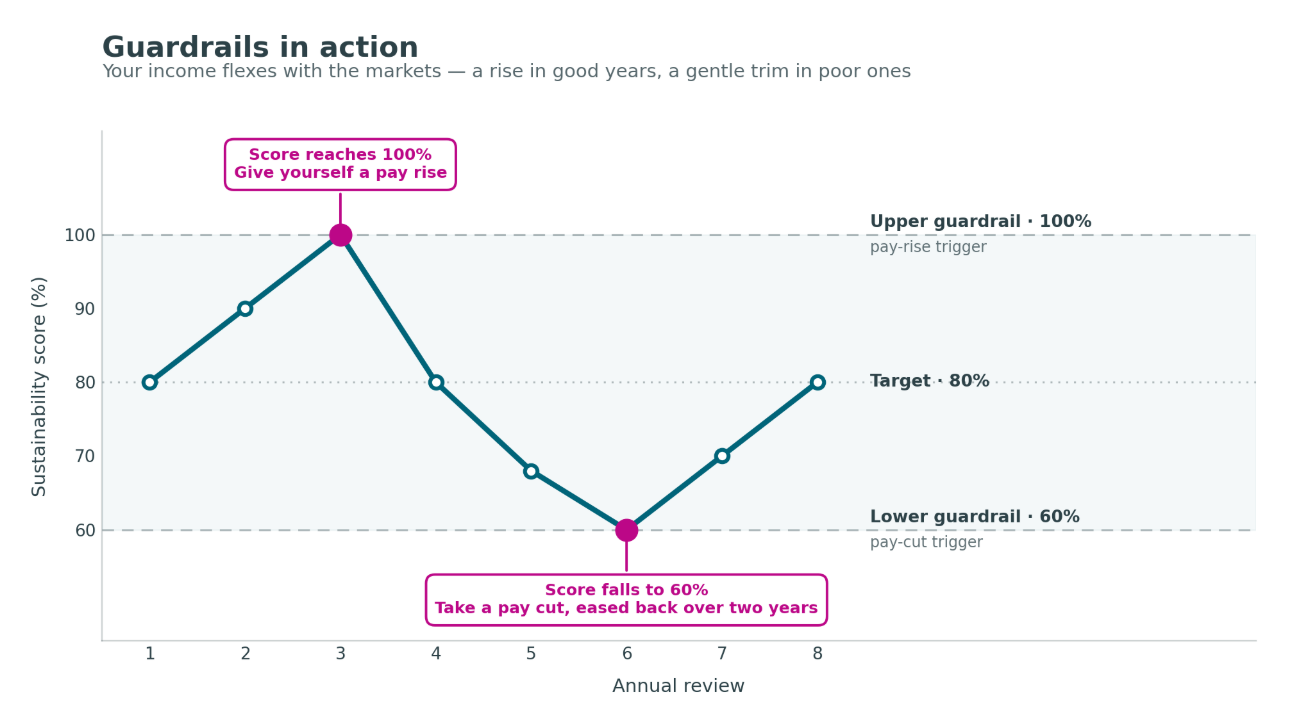
If your sustainability score has drifted up to 100%, you can give yourself a pay rise, bringing it back down to 80%.
If your score has slipped down to, say, 60% — perhaps an unforeseen outgoing landed at the same time as a poor run in markets — you take a pay cut to bring it back up.
There's an important subtlety in that last step. We don't rush to get you back to 80% in a single year. Markets typically snap back, so an aggressive cut on the back of one bad spell tends to over-correct. Instead we'd usually recalibrate to around 70% in the first year, then to 80% in the second, easing rather than lurching.
This approach is illustrated in the chart below:
Protection Against Sequencing Risk
This is what makes guardrails a genuine hedge against sequencing risk. Spending is gently tapered when returns disappoint, and restored — or increased — when they recover. And in our experience most clients have exactly this kind of flexibility built into their lives already: deferring a car replacement or a major holiday for twelve months is rarely a hardship, and it's often all that's needed to steer safely through a rough patch.
A worked example
As ever, this is best described by way of an example:
Michael and Ana are both 66 and have recently retired. Between them they have around £850,000 invested across pensions and ISAs, and both receive the full New State Pension — around £24,000 a year combined.
Year One
Our stochastic analysis suggests they can comfortably spend £60,000 a year whilst maintaining an 80% sustainability score through to age 100.
Around £24,000 comes from their State Pensions and £36,000 from their investment portfolio.
Their essential spending is closer to £52,000, leaving around £8,000 of discretionary spending. Rather than simply letting it accumulate, they decide to help their two children financially.
End of year one
The first year of retirement proves difficult. Markets fall, inflation remains stubbornly high, and after withdrawals their portfolio has fallen to around £700,000.
We rerun the analysis and their sustainability score has dropped to around 60%.
Rather than blindly carrying on or making dramatic cuts, we simply recalibrate the plan. Their target spending falls modestly to around £53,000 for the following year.
In practice, this might mean postponing the gifts to their children, opting for a more modest holiday, or delaying the replacement of their car for another year. Their day-to-day lifestyle changes very little, but those relatively small adjustments reduce the pressure on the portfolio whilst markets recover.
End of year two
Fortunately, that's exactly what happens. Markets rebound, the portfolio recovers to around £780,000, and a fresh analysis sees their sustainability score climb back into the low 80s.
With the plan back on track, they increase spending again to around £58,000. The gifts resume, they replace the car, and next year's holiday returns to the original plan.
That's the essence of risk-based guardrails. Income isn't fixed forever; it adapts to the strength of your financial position. When markets are weak, you tighten the belt a notch. When they're strong, you enjoy the rewards.
These figures are for illustrative purposes only and do not reflect actual investment returns, which can fluctuate and are not guaranteed. The tax implications of pension withdrawals will be based on your individual circumstances, tax legislation and regulation which are subject to change in the future.
Summary
Building a retirement pot is only half the job — spending it sensibly is the other, and it's the half most people think about least.
Enter risk-based guardrails: a flexible approach that lets your retirement income rise when markets are strong and ease back modestly when they aren't, guarding against both running out of money and the more common trap of spending too little. It's a far smarter alternative to rigid rules of thumb like the 4% rule or only drawing on investment income while leaving the capital untouched.
As always, if you’d like to know more, or explore your own stochastic modelling and guardrails strategy, please let us know.
Happy Thursday.
Kind regards,
George
Referrals Welcome
Our business grows mainly through personal recommendations. If you know someone—whether a friend, family member or colleague—who might benefit from financial planning, we’d be grateful if you could share my details with them. Alternatively, you can pass their details on to me, and I’ll be happy to reach out.
Regulatory Information
Blincoe Financial Planning Limited is an appointed representative of Sense Network Ltd, which is authorised and regulated by the Financial Conduct Authority. Registered in England & Wales (No. 14569306). Registered Office: Star Lodge, Montpellier Drive, Cheltenham, GL50 1TY.
Important Disclaimer
This blog is for general information only and is intended for retail clients. It does not constitute financial or tax advice, nor is it an offer to buy or sell any specific investment. Since I don’t know your personal financial situation, you should not rely on this content as tailored advice. While we aim to provide accurate and up-to-date information, we cannot guarantee that all details remain correct over time. We are not responsible for any losses resulting from actions taken based on this blog’s content.
Start here
Wondering if we'd be a good fit?
Answer a few short questions about your situation. If it looks like we can help, you can book an introductory call with one of our planners at the end.
See if we're a good fitTwo minutes. No obligation.