
How Annuities Work, When They Make Sense, and Why the Case for Them Is Stronger Than It's Been in Years

(image created by AI; article written by me)
Is now the time to secure some guaranteed income?
Rising gilt yields have pushed annuity rates to near 20-year highs, making guaranteed retirement income far more attractive than it was during the era of near-zero interest rates. Three factors - strong markets, high annuity rates, and the April 2027 pension inheritance tax changes - are aligning to make now a compelling moment to consider securing an income floor.
Annuities have had something of a 'Lazarus moment'.
For years they were on the substitutes' bench. Following the 2015 'pension freedoms' and the subsequent era of near-zero interest rates, the proposition was a poor one: exchanging a sizeable portion of your pension savings — money that could otherwise be accessed flexibly, and cascaded down through the generations free of inheritance tax — for a paltry guaranteed level of income.
You essentially traded a significant capital sum for a modest yield, sacrificing all the flexibility inherent in drawdown. They fell out of favour, and quite rightly so.
But they're back.
The primary catalyst has been the shift in interest rates. Because annuity rates are tethered to government bond yields, their ascent to levels not seen in almost two decades has pulled annuity rates upward in tandem. The guaranteed income you can now secure for every pound of your pension is vastly improved on only a few years ago.
This is precisely why annuities have returned to the conversation. In this week's blog, we explore how far these rates have climbed — and whether now represents a prudent moment to secure your position.
Please note, a pension is a long-term investment and funds are not normally accessible until 55 (rising to 57 from April 2028). When investing via a pension, your capital is at risk. The fund value may fluctuate and can go down, which would have an impact on the level of pension benefits available. Your pension income could also be affected by the interest rates at the time you take your benefits. The tax implications of pension withdrawals will be based on your individual circumstances, tax legislation and regulation which are subject to change.
Building an income floor
Regular readers will be familiar with our views on annuities.
Rather than 'annuitising' your entire pension pot, we prefer to use an annuity to secure a guaranteed minimum 'income floor' — allocating only a portion of your savings to lock in a dependable income for life.
Paired with your other secured sources — the State Pension, any defined benefit schemes you hold, predictable rental profits — this should comfortably cover your essential outgoings. The food, the utilities, the council tax: the non-negotiables that must be met regardless of market conditions. Ideally, you'd want a modest buffer on top, too, to fund the predictable pleasures of retirement — your hobbies, or dining out.
By using an annuity to bridge this gap, you have effectively bought out the risk of running out. Whatever is going on in the world, the essentials are always covered.
The bigger benefit, though — in our view — is how this reframes your remaining wealth.
It draws a definitive boundary. Everything else — your residual pension savings, your liquid investments— is now clearly designated for lifestyle spending or gifting. You gain the freedom to enjoy it, or to pass it on, without the persistent worry that you might one day need those funds simply to keep the lights on. You have insured against the risk of outliving your money, and there is immense value in that peace of mind.
But the spreadsheet says stay invested
Run the figures through a spreadsheet — comparing an annuity purchase with staying invested and drawing flexibly — and the mathematical conclusion will almost certainly favour the latter.
Put simply, why trade your capital for a fixed income of 6% or 7% when you could retain the principal and harvest the returns markets have historically provided? Over recent history, even a balanced '60/40' portfolio has compounded at around 6–7% a year.
It is a valid challenge, and on a strictly numerical basis the spreadsheet often makes a compelling case. But there are dimensions to this decision that defy simple calculation.
The first is certainty. Spreadsheets rely on assumed returns, projecting historical averages as though they were guaranteed. Yet no one truly knows the market's trajectory over the next two decades.
The second is emotional, and notoriously hard to model. There is a profound security in knowing — not merely hoping — that your essential costs are covered for life. It changes the retirement experience entirely, letting you spend your remaining capital with a clear conscience rather than a nagging sense of worry.
The inheritance tax change tilts the balance further
There is another significant shift under way.
Until recently, one of the primary reasons to leave a pension untouched was its exemption from inheritance tax, which made it a near-perfect tool for passing wealth down the generations. The logic was simple: spend your other assets first, and leave the tax-free pension to your heirs.
That advantage is set to diminish. From April 2027, pensions will be brought within the scope of inheritance tax — placing, for those in the crosshairs of IHT, an effective 40% liability on the remaining pot. The pension therefore reverts to its original purpose: providing a retirement income. And if its job is once again to fund your retirement, securing that income through an annuity starts to look considerably more attractive than it did previously.
As good as it gets?
Is now a good time to buy an annuity? Looking at the current environment, three factors are aligning in a rather interesting way.
First, we have seen a remarkable market run. Selling a portion of those investments to lock in a guaranteed income while you are in a position of strength is a logical move — and effectively banks some of those returns.
Second, annuity rates are at their highest in almost two decades — comfortably the best terms most current retirees will have seen in their adult lives. The yields on offer are generous by any modern metric.
Third, and more speculatively, we could be on the cusp of a leap in longevity (which could weigh on future annuity rates).
I address each in more detail below.
1. Market returns
By way of an example, our preferred Risk Level 7 strategies (a 70/30 equity–bond split) are up around 40% over the last three years alone, implying an annualised return of roughly 11.6%. So if you had deferred an annuity purchase for, say, three years, your starting pot is likely 30-50% larger today — depending on your risk profile, asset allocation, and underlying investment selection of course.
2. Annuity rates
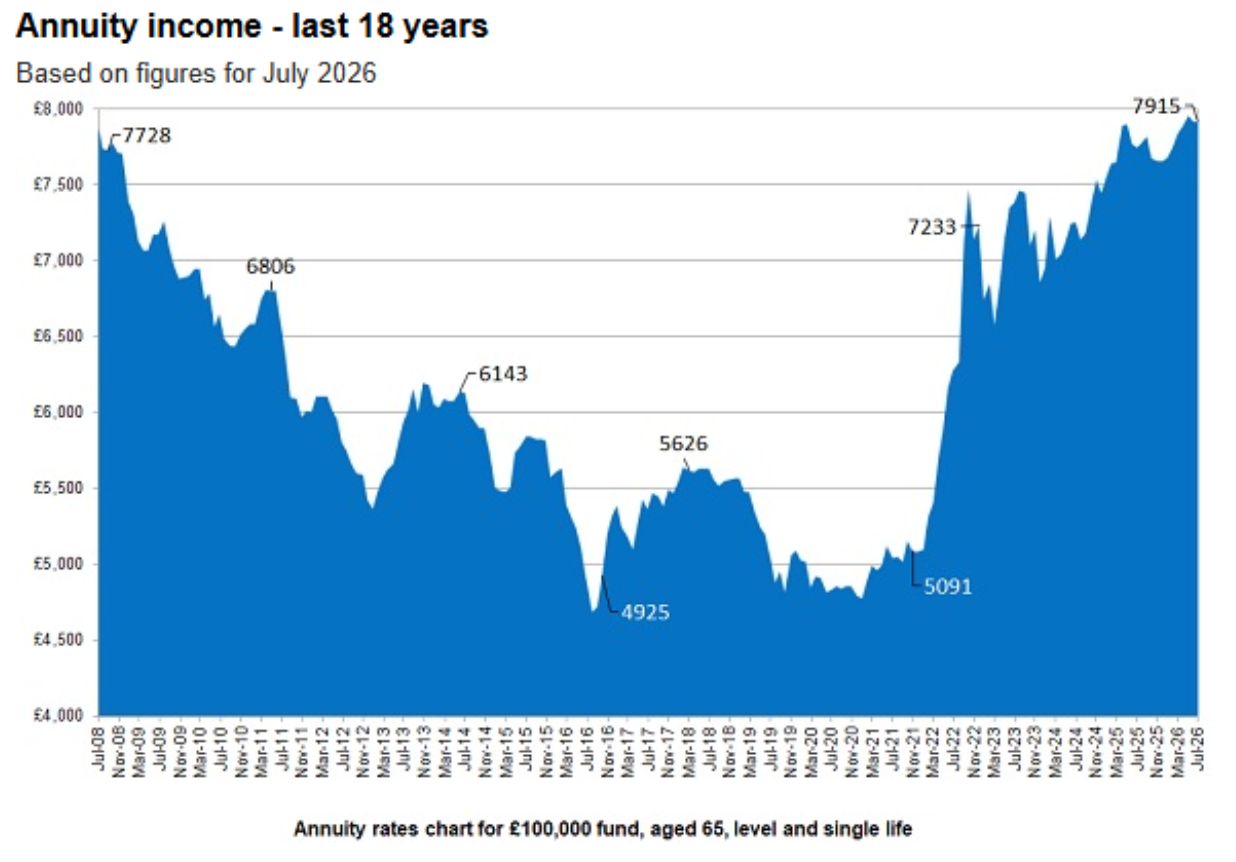
The chart below shows the evolution of annuity rates over the last eighteen years. It is based on the annual income that £100,000 of pension savings could buy for a 65-year-old, on a level, single-life basis, with no guarantee period and standard terms.
Source: sharingpensions.co.uk
In other words, a healthy 65-year-old could currently convert £100,000 of pension savings into around £7,915 a year of guaranteed income — on a level basis, with no spouse's pension or guarantee period. That is a rate of 7.9%.
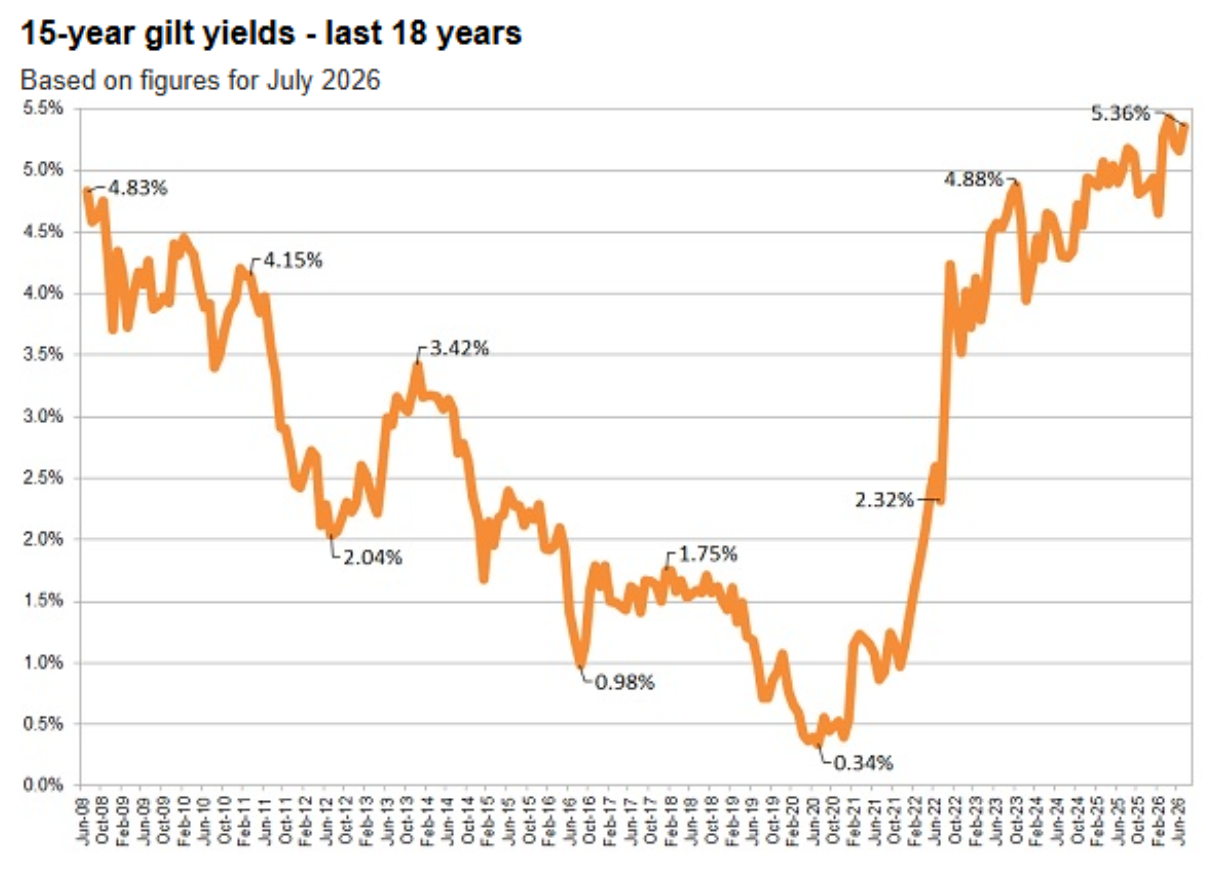
The reason for the increase is that gilt yields have risen too. Here is the equivalent chart of 15-year UK gilt yields:
Source: sharingpensions.co.uk
As you can see, the two follow a very similar pattern.
The rise in gilt yields itself owes to a mix of resurgent and then 'sticky' inflation, alongside increasingly stretched public finances.
The key point here is that factors 1 and 2 have both worked in annuities' favour at once. The swelling pension base lifts the starting pot available to secure a guaranteed income; the rising rates increase the income that pot can buy. Win-win.
But it won't always be like this. Higher interest rates mean higher gilt yields, which — beyond a point — generally weigh on equity valuations. If rates were to climb much further from here, history suggests equity prices would feel it. That is precisely what happened in the 'annus horribilis' of 2022: soaring inflation drove soaring interest rates, and equities sold off sharply. It is rare to have both high interest rates and elevated stock markets at the same time.
3. Longevity
The third factor is the most debatable, and I expect some healthy scepticism — but I think there is a compelling case to be made.
Insurers set annuity rates according to life expectancy. If we live longer, rates must fall to account for the longer payout period. And a number of scholars now suggest we may be on the verge of a meaningful leap in how long we live.
Artificial intelligence is already accelerating pharmaceutical breakthroughs and shifting medicine from a reactive model to a proactive one — catching illnesses long before symptoms appear.
I confess I'm something of a magpie drawn to shiny things, but I'm an example of this myself: I use wearable tech to monitor my health metrics constantly, and next week I'm heading for an annual health scan — in the hope that anything nasty lurking beneath the surface is picked up early. If we move towards a future of widespread preventive care, lifespans could extend significantly.
If life expectancy trends upward, the terms on offer are more likely to tighten than to improve.
Our preference: a blend of level and inflation-linked
If you decide that an annuity fits your plan, the structure is just as vital as the timing.
We typically favour a 50/50 split between a level annuity and one that is linked to inflation.
A level policy provides a higher initial income but its purchasing power will be eroded by rising costs over time.
Conversely, an inflation-linked policy starts lower but increases annually to protect your standard of living.
By blending the two, you secure a higher starting income for those more active early retirement years while maintaining a vital defence against inflation for the long term. For the majority of clients, this middle ground offers the best balance of immediate benefit and future security.
The risks
As with any financial decision, there are no free lunches. It is important to be transparent about the risks involved in annuity purchase.
The most significant point is that an annuity is final. Once you commit, the capital is gone, and you lose the ability to change your mind. While the coming tax changes make pensions slightly less attractive as an inheritance tool, annuitising still represents a loss of flexibility and potential legacy.
Inflation remains a persistent threat. While a blended approach helps, the level portion of your income will still lose value each year, and a period of high inflation could still be painful.
There is also the opportunity cost to consider. Rates might continue to rise after you lock in, or the stock market could continue to outperform the fixed yield of an annuity. Furthermore, if you pass away much earlier than expected, you may receive less in income than you paid in capital—though you can mitigate this with guarantee periods or joint-life features at the cost of a lower starting rate.
On a more positive note, the risk of an insurer failing is often overstated. Annuities are classed as long-term insurance contracts, which are covered by the FSCS in full, with no upper limit.
In summary
We have discussed annuities many times over the years, and for some, this will be familiar territory. However, given the current alignment of strong markets, generational high rates, and the shifting tax landscape, there is a strong case for revisiting the conversation now.
As always, this blog should not be treated as personal advice. The right path depends entirely on your specific goals and financial picture. But if these points resonate with you, I would welcome the opportunity to sit down and review your numbers together.
Happy Thursday.
Kind regards,
George
Referrals Welcome
Our business grows mainly through personal recommendations. If you know someone—whether a friend, family member or colleague—who might benefit from financial planning, we’d be grateful if you could share my details with them. Alternatively, you can pass their details on to me, and I’ll be happy to reach out.
Regulatory Information
Blincoe Financial Planning Limited is an appointed representative of Sense Network Ltd, which is authorised and regulated by the Financial Conduct Authority. Registered in England & Wales (No. 14569306). Registered Office: Star Lodge, Montpellier Drive, Cheltenham, GL50 1TY.
Important Disclaimer
This blog is for general information only and is intended for retail clients. It does not constitute financial or tax advice, nor is it an offer to buy or sell any specific investment. Since I don’t know your personal financial situation, you should not rely on this content as tailored advice. While we aim to provide accurate and up-to-date information, we cannot guarantee that all details remain correct over time. We are not responsible for any losses resulting from actions taken based on this blog’s content.
Start here
Wondering if we'd be a good fit?
Answer a few short questions about your situation. If it looks like we can help, you can book an introductory call with one of our planners at the end.
See if we're a good fitTwo minutes. No obligation.