
Should I Just Invest in US Tech Stocks? The Case Against Recency Bias in Portfolio Construction

(image created by AI; article written by me)
The Past is History, The Future’s a Mystery
After 15 years of US equity dominance, with the Magnificent Seven driving 50–60% of S&P 500 returns, recency bias is one of the most prevalent risks in investing today. This blog explains why extrapolating recent performance is dangerous, what history tells us about concentrated market leadership, and why diversification remains essential.
We've written before about the large number of emotional biases and cognitive errors prevalent in managing one's own investments — loss aversion (running losers and taking profits on winners too soon), overconfidence (putting strong performance down to one's own skill rather than a generally bullish equity environment), home bias (over-concentration in UK stocks — bear in mind the UK now makes up less than 4% of the global stock market), confirmation bias (ignoring any news that runs counter to your holding), and so on. We'll revisit the full list in due course. But one bias we're seeing more and more of lately is recency bias.
Recency bias is the tendency to give more weight to recent events than to older data, and to assume that recent trends will simply continue into perpetuity. It's not a criticism — it's human nature. We naturally extrapolate from the last three to five years, because that's what's freshest in the mind.
In fact, it’s not just three to five years. Stock markets have been so strong for the past 15 years that anyone under the age of 40 has likely never lived through a genuinely difficult bear market as an investor.
In this context, recency bias is showing up in three recurring questions:
Why would I own anything but equities (aka. stocks and shares)?
Why would I own anything but US equities?
Why would I own anything but US tech stocks?
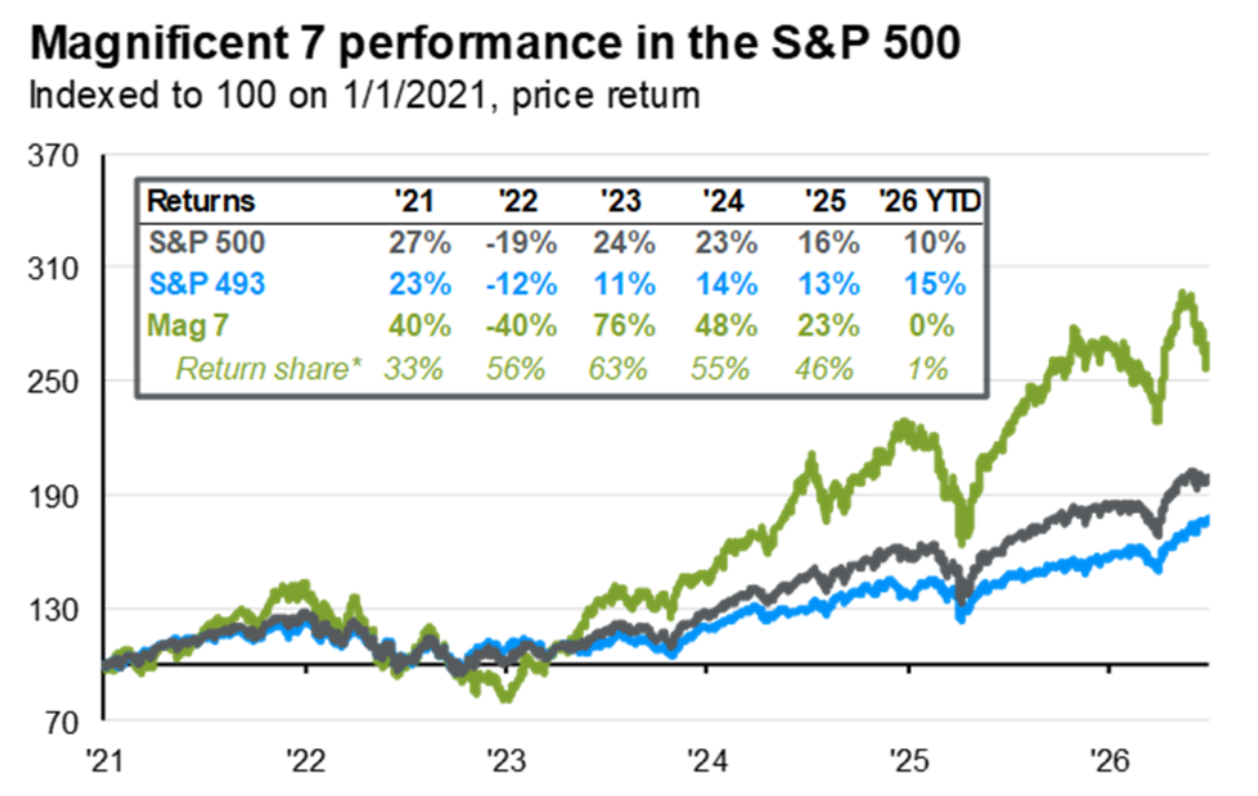
That’s because equities have been the dominant asset class for the last 15 years, skewed heavily towards US equities, skewed heavily towards a handful of US tech stocks.
This is illustrated in the two charts below. Chart 1 is the 'classic' quilt chart, showing the performance of the main asset classes over the last fifteen years. The asset labelled 'Large Cap' is the S&P 500, the benchmark US equity index, which has appeared at or near the top of the table in the vast majority of years.
The second chart compares the S&P 500 with the 'Magnificent Seven' tech stocks — Apple, Alphabet, Amazon, Nvidia, Microsoft, Tesla and Meta — and shows not only the extent of their recent outperformance, but the share of S&P 500 returns they've driven between them: around 50–60% on average.
Chart 1: Quilt Chart
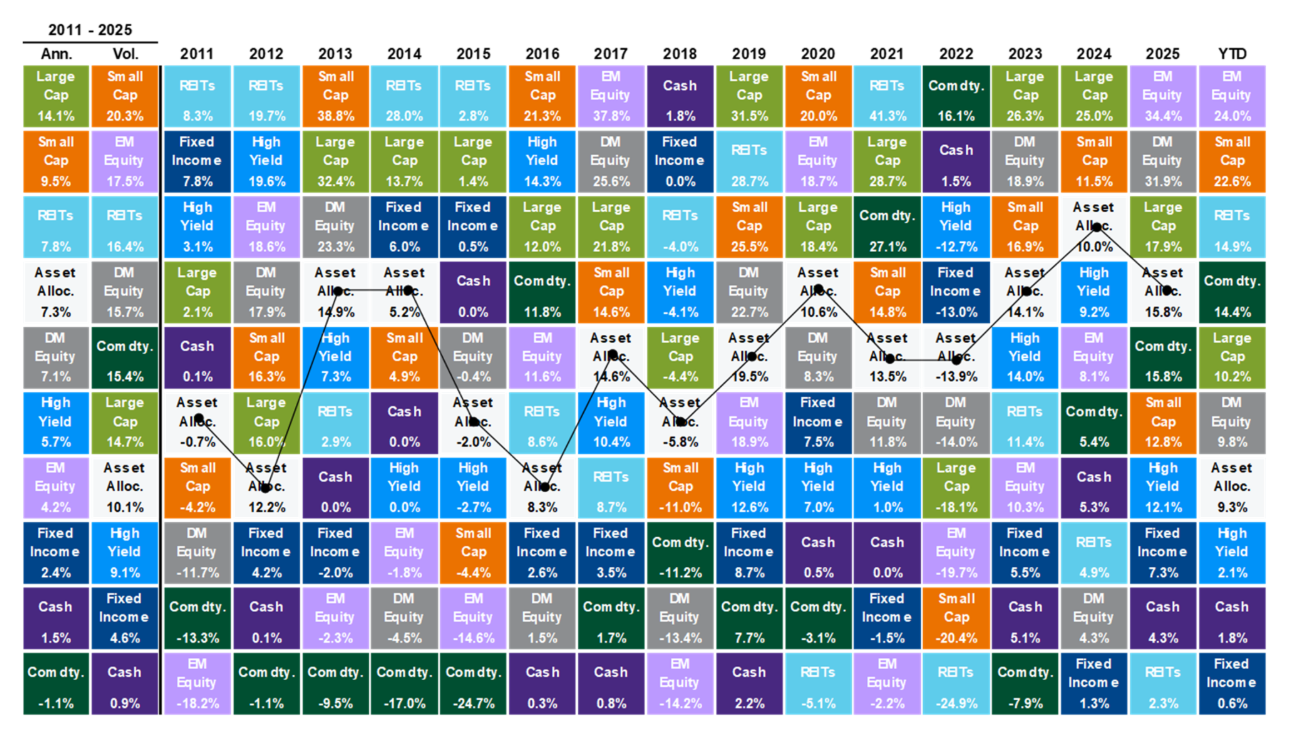
Chart 2: S&P 500 vs Magnificent Seven
Source: J.P.Morgan’s Guide to the Markets
When investing, your capital is at risk. The value of your investment (and any income from them) can go down as well as up, and you may get back less than you invested.
Recency Bias in Investing
When one part of the market has pulled away from everything else for well over a decade, it is natural to conclude that this is simply the way of things.
The temptation is to extrapolate those relatively recent returns — recent, at least, in the long sweep of market history — forward indefinitely: to assume that the current technology giants are certain to be the artificial intelligence winners and compound their advantage, and that everything else will be left behind. It is why a growing number of investors now question whether there is any purpose in diversifying geographically beyond the United States at all, when doing so has been a drag on returns for so long.
This euphoria is understandable, precisely because the outperformance has persisted for so long. We have not experienced a genuinely difficult market for almost twenty years — not since the global financial crisis of 2007–09. Most people do not begin investing in a meaningful, deliberate way — beyond their workplace pensions, at least — until their thirties, which means that the majority of those below their mid-to-late forties have not lived through a properly severe market as an investor.
To be clear, I'm not predicting that the end is nigh — I firmly believe in the long-term compounding nature of equities. As long as humans continue to innovate and companies remain motivated to turn a profit, the chart should keep sloping upwards.
However, the risk of complacency born of recency bias is a real one.
History Lesson
History offers two episodes that give pause for thought.
1. Dot-Com Bubble
The first is the dot-com bubble. By 1999, the NASDAQ Composite was trading on a price-to-earnings ratio that had astonishingly surpassed 90, while the S&P 500's own valuation had reached what was then a record high. At the turn of the century, these valuations proved unsustainable: the NASDAQ plunged 78% to a low of 1,114.11 by October 2002, while the broader S&P 500 fell 49% from its peak. Over 50% of public dot-com companies had failed by 2004.
Barely a decade later came the financial crisis. The near-uninterrupted bull run we have since enjoyed was preceded by what is often called a lost decade: across the 2000s, the S&P 500 produced a real (i.e. inflation-adjusted) return of minus 7.0% annualised, with the NASDAQ-100 doing even worse at minus 10.4% annualised.
Note here, we think some of the comparisons between today's US stock market and the dot-com boom are a little overdone. Valuations are less stretched, cash positions are stronger, and earnings growth is far more robust. In fact, this year's US market returns have been exceeded by rising earnings expectations, meaning valuation multiples have actually come down.
But I do see a separate risk: AI commoditisation.
In my personal view (hardly a bold one), the AI revolution is entirely real, and potentially more transformative than the internet, mobile communications, and the railways put together. The difficulty is that competition looks set to be so intense that the so-called ‘hyperscalers’ may struggle to meet the lofty expectations embedded in their valuations, with much of the value commoditised rather than captured by a handful of clear winners.
We saw a striking preview of this in early 2025, when the Chinese model DeepSeek broadly matched the leading US Large Language Models (OpenAI, Claude, etc.) at a fraction of the cost. A revolution can be entirely genuine and still prove a poor investment, if you overpay for it.
2. Japanese Equities
The second history lesson is Japan.
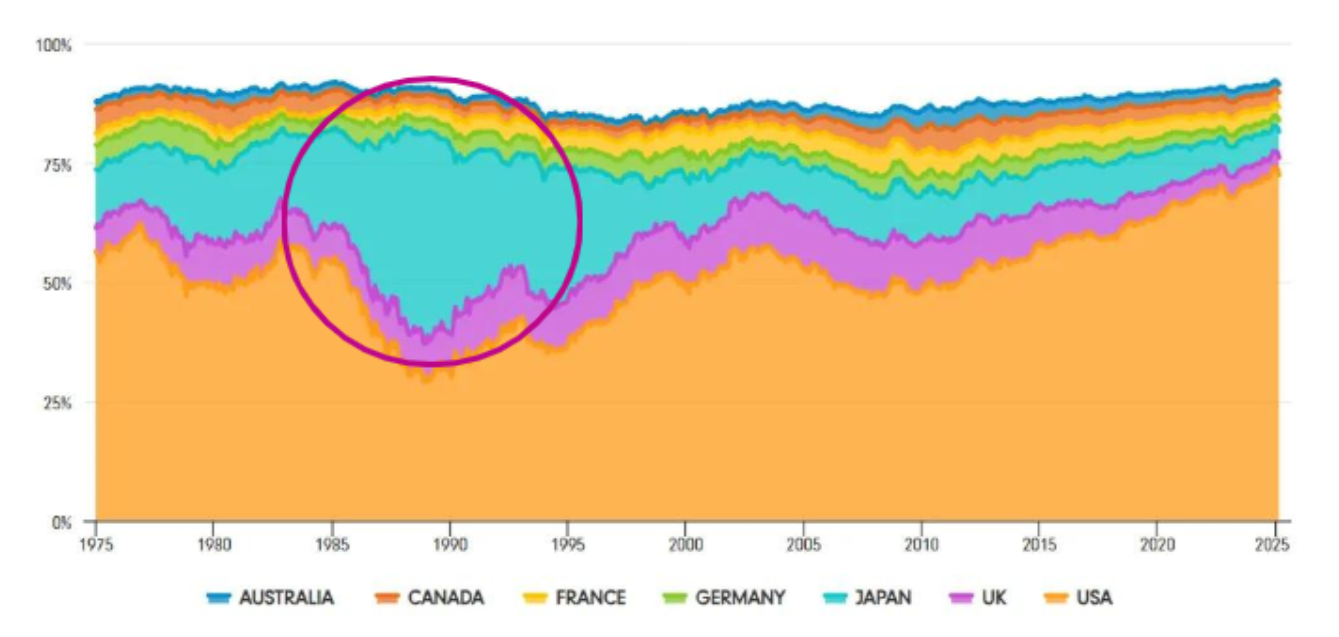
In the late 1980s, Japan was the equity market everyone wanted to own, as the world went crazy for Japanese consumer exports — driving a Toyota, listening to a Sony Walkman, watching TV on a Panasonic set.
At the peak, the total value of Japanese stocks reached around $4 trillion, close to 45% of the world's entire equity market capitalisation - see chart below:
Chart 3: MSCI World Country Weightings Through Time
Source: Workspace Refinitiv, 2025
Valuations had become similarly stretched: by 1989, the Nikkei traded on a price-to-earnings ratio of around 60 times trailing twelve-month earnings — several multiples above what would be considered reasonable today.
It did not end well. What followed was not one lost decade but three: the Nikkei reached a high of almost 39,000 at the very end of 1989 and did not surpass that level again until February 2024 — a wait of around thirty-four years.
I offer these examples not to alarm, but as a reminder that the phrase "this time is different" has been spoken many times before.
The Case for Bonds
Just as many investors are extrapolating extraordinary equity returns forward, I encounter the mirror image where bonds are concerned: persistent scepticism.
The argument runs that inflation will remain elevated, that this implies upward pressure on interest rates, and that this in turn implies downward pressure on bond prices. Public finances add to this concern: governments across the developed world are running persistent, elevated budget deficits — spending considerably more than they raise in revenue — which itself puts upward pressure on bond yields.
Yet consider the other side of the same story. What if the AI revolution proves disinflationary — if companies secure efficiency savings sufficient to hold prices steady, or even reduce them? And what if AI's impact extends further still, boosting productivity growth and, in turn, economic growth — naturally improving the fiscal picture rather than worsening it?
Should inflation ease, bonds ought to return to favour.
Just as importantly, they should once again prove their worth as a diversifier against equities in any growth-led slowdown — precisely as they did in 2008–09.
What This Means For How We Invest
Diversification is central.
We continue to believe firmly in the merits of diversifying both globally and by style. Our central proposition tilts towards companies that are relatively inexpensive against their fundamentals (value), towards smaller companies over the very largest, and towards profitable companies over unprofitable ones, with a modest bias towards emerging market equities alongside.
Has this underperformed the S&P 500 or the NASDAQ over the past few years? It has — but then, so has almost everything else. And it's not about the last ten years; it's about the next. Most of our clients have a 20–30 year time frame, if not longer.
In summary
Beware recency bias. It is among the most natural things in the world to observe what has performed well of late and to assume that it always will; yet history is replete with examples of precisely that assumption ending in disappointment. Markets rotate, leadership changes, and the extraordinary run of US equities may well continue for some time yet — I hope that it does. To build an entire financial plan on the conviction that it must, however, is another matter entirely.
The past is not an indicator of the future. Diversify, remain disciplined, and do not allow the recent past to do your forecasting for you.
Happy Thursday.
Kind regards,
George
Referrals Welcome
Our business grows mainly through personal recommendations. If you know someone—whether a friend, family member or colleague—who might benefit from financial planning, we’d be grateful if you could share my details with them. Alternatively, you can pass their details on to me, and I’ll be happy to reach out.
Regulatory Information
Blincoe Financial Planning Limited is an appointed representative of Sense Network Ltd, which is authorised and regulated by the Financial Conduct Authority. Registered in England & Wales (No. 14569306). Registered Office: Star Lodge, Montpellier Drive, Cheltenham, GL50 1TY.
Important Disclaimer
This blog is for general information only and is intended for retail clients. It does not constitute financial or tax advice, nor is it an offer to buy or sell any specific investment. Since I don’t know your personal financial situation, you should not rely on this content as tailored advice. While we aim to provide accurate and up-to-date information, we cannot guarantee that all details remain correct over time. We are not responsible for any losses resulting from actions taken based on this blog’s content.
Start here
Wondering if we'd be a good fit?
Answer a few short questions about your situation. If it looks like we can help, you can book an introductory call with one of our planners at the end.
See if we're a good fitTwo minutes. No obligation.