

(image created by AI; article written by me)
By George Taylor, CFA
Published: 12/11/2026
The art of knowing when to do nothing
Rebalancing a portfolio only when it drifts beyond agreed limits, rather than on a fixed calendar, has historically produced better long-term outcomes. Across 972 historical 30-year periods, a 10% tolerance approach needed just 3 rebalances and beat quarterly rebalancing (120 rebalances) by around £74,000 on a £100,000 70/30 portfolio.
One of the golden rules of investing is to buy low and sell high.
Sounds simple enough. Yet, in practice, fear and greed often lead investors to do precisely the opposite.
When markets are rising, confidence grows and investors become increasingly comfortable taking risk. When markets fall, fear takes over and the temptation is to sell.
Portfolio rebalancing provides a disciplined way of countering these behavioural biases.
It also serves another, arguably more important purpose: ensuring your investments remain aligned with your agreed level of risk.
However, there's a balance to be struck. Rebalance too frequently and you risk interrupting the compounding of returns, while incurring unnecessary trading costs. Rebalance too infrequently and your portfolio can drift significantly from its intended risk profile.
So, what's the optimal approach?
What is portfolio rebalancing?
Rebalancing is the process of buying and selling investments to restore a portfolio to its intended asset allocation.
For example, let's assume you have a £100,000 portfolio, invested 70% in equities (stocks and shares) and 30% in bonds (fixed income).
Equities are the growth engine of the portfolio, historically delivering superior long-term returns, albeit with greater volatility. Bonds generally provide a degree of stability and diversification. The 70/30 split is deliberate, reflecting your investment objectives and agreed risk profile.
However, this allocation won't stay at 70/30 indefinitely.
If equities outperform bonds, their weighting will gradually increase. Over time, what started as a 70/30 portfolio could become 80/20 or even 90/10.
You've effectively taken on more investment risk without consciously deciding to do so.
This is known as portfolio drift, and it's the principal reason we rebalance.
Buy low, sell high
Rebalancing also has the potential to enhance investment returns.
That's because it introduces an automatic 'buy low, sell high' discipline, taking profits from assets that have performed strongly and recycling the proceeds into those that have lagged.
This plays into the cyclical nature of financial markets, whereby yesterday's top performers are rarely tomorrow's.
Think back to the technology boom of the late 1990s, followed by the dot-com crash. Or the years leading up to the 2008 global financial crisis, when seemingly unstoppable equity markets suffered a dramatic reversal.
Rebalancing encourages investors to take some profits during the good times and reinvest following market declines.
However, there's a catch.
Assets can outperform for prolonged periods. Selling them too early, or too frequently, can mean missing out on substantial further gains.
And every time we rebalance, we potentially incur trading costs, which compound over time.
The challenge is therefore to capture as much of the upside as possible, without allowing portfolio risk to become excessive.
A smarter way to rebalance
Traditionally, many investment managers have adopted a calendar-based approach, rebalancing portfolios monthly, quarterly or annually, regardless of market conditions.
However, there's growing evidence to suggest that a tolerance-based approach may deliver better long-term outcomes.
Rather than rebalancing at predetermined intervals, this approach allows portfolios to drift within agreed limits, with adjustments made when those limits are reached.
For example, a 70/30 portfolio with a 10% relative tolerance would be permitted to fluctuate between 63% and 77% equities.
Once either threshold is reached, the investment manager would then rebalance the portfolio towards its original 70/30 allocation.
This provides a sensible compromise between:
Allowing outperforming assets to continue growing.
Preventing the portfolio from taking on excessive risk.
Minimising unnecessary trading costs.
At Blincoe, we subscribe to this investment philosophy, which is reflected in the approach taken by investment managers such as Timeline and Dimensional, to whom we entrust the day-to-day management of our clients' investments.
We believe it strikes a sensible balance between giving portfolios room to capture additional returns and maintaining appropriate control over investment risk.
What does the research tell us?
Timeline recently published a research paper examining different rebalancing strategies across more than a century of financial market history.
The study analysed 972 overlapping 30-year investment periods, comparing quarterly and annual rebalancing with tolerance-based approaches.
The results were compelling.
Consider a £100,000 portfolio invested 70% in global equities and 30% in bonds (i.e. a common 70/30 allocation), over 30 years:
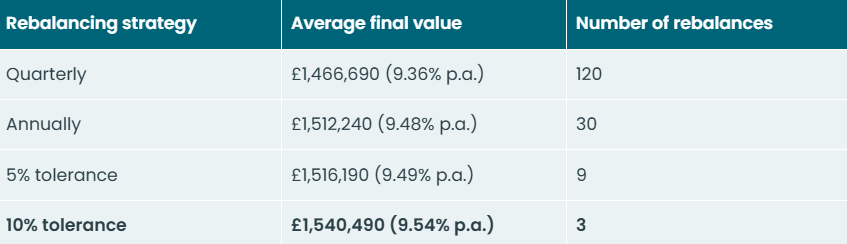
Source: Timeline, Evidence-Based Rebalancing (2026). Average outcomes across historical 30-year periods. Figures include an assumed 1% annual fee but exclude transaction costs, taxes and inflation.
The 10% tolerance approach delivered the highest average final portfolio value, approximately £74,000 more than quarterly rebalancing.
Interestingly, the difference in annualised returns was relatively modest: 9.54% per annum versus 9.36%, an improvement of just 0.18 percentage points.
But as the table demonstrates, even seemingly small differences in annual returns can compound into substantial sums over a long period of time.
Perhaps more strikingly, the 10% tolerance approach required just three rebalances over 30 years, compared with 120 under the quarterly approach.
On that basis, the performance gap could potentially be wider still. The research doesn't account for transaction costs, which can mount up with frequent trading. Rebalancing can also involve brief periods when money is held in cash between trades, potentially missing out on market returns. Fewer rebalancing events could therefore provide an additional advantage, although the impact will depend on how efficiently trades are executed and how markets behave during those periods.
Of course, there's an important reason why less frequent rebalancing has historically worked well, particularly in portfolios combining equities and bonds.
Equities have generally outperformed bonds over the long term, reflecting the additional risks investors take when owning shares rather than lending money.
And that creates an interesting challenge for rebalancing.
If two investments delivered similar long-term returns but regularly took turns outperforming one another, selling the winner and buying the laggard could work particularly well.
But equities and bonds aren't equal in that respect. Equities have historically delivered higher long-term returns, and we would generally expect them to continue doing so (albeit with no guarantees). Consequently, repeatedly selling equities to buy bonds can mean reducing exposure to the asset class with the greater long-term growth potential.
Rebalance too frequently, and you risk sacrificing returns in the name of managing risk.
So why rebalance at all?
Because there's another side to the equation.
If left unchecked, a portfolio originally invested 70% in equities could gradually become 80%, or even 90% equity-heavy.
And whilst that might improve long-term returns, it also exposes you to potentially much larger losses when markets fall.
To put that into perspective, consider two of the investment strategies we commonly recommend.
During the height of the 2008 Global Financial Crisis, the Timeline Classic 70 portfolio, which targets approximately 70% equities, experienced its worst one-year decline, losing around 24% of its value.
For the Timeline Classic 100 portfolio, invested entirely in equities, the corresponding decline was approximately 36%.
Both would feel pretty awful. But there's a meaningful difference between watching £100,000 fall to £76,000 and seeing it fall to £64,000.
And the question is: could you stomach that additional loss without panicking and selling? Because the biggest risk isn't necessarily the market downturn itself, it's how you react to it.
An investor who discovers they've inadvertently taken on far more risk than they're comfortable with might be tempted to sell after a major market correction, locking in losses and potentially missing the subsequent recovery.
That's precisely what a disciplined rebalancing strategy is designed to help prevent.
Summary: it's a rebalancing act
We caution against rebalancing too frequently.
The historical evidence suggests that constantly resetting portfolios to their target allocation can be counterproductive. It creates additional trading costs, can involve brief periods out of the market, and may reduce long-term returns by repeatedly trimming exposure to equities.
But we certainly wouldn't advocate abandoning rebalancing altogether.
Rebalancing is fundamentally about controlling risk, not maximising returns. It helps prevent a portfolio from gradually becoming more equity-heavy than intended, whilst introducing a disciplined mechanism for taking some profits after periods of strong performance and reinvesting following market declines.
The challenge is knowing when to intervene.
Too often, and you risk unnecessarily sacrificing returns.
Too infrequently, and you risk taking on more investment risk than you can comfortably tolerate.
As ever, it's a balancing act. Or, perhaps more appropriately, a rebalancing act.
And that's why we subscribe to a tolerance-based approach, as adopted in various forms by investment managers such as Timeline and Dimensional.
It gives investments room to grow, without allowing portfolio risk to drift indefinitely away from what's appropriate for you.
Because ultimately, the best investment strategy isn't necessarily the one that delivers the highest returns. It's the one you can stick with, through good markets and bad.
Happy Thursday.
Kind regards,
George
Referrals Welcome
Our business grows mainly through personal recommendations. If you know someone—whether a friend, family member or colleague—who might benefit from financial planning, we’d be grateful if you could share my details with them. Alternatively, you can pass their details on to me, and I’ll be happy to reach out.
Regulatory Information
Blincoe Financial Planning Limited is an appointed representative of Sense Network Ltd, which is authorised and regulated by the Financial Conduct Authority. Registered in England & Wales (No. 14569306). Registered Office: Star Lodge, Montpellier Drive, Cheltenham, GL50 1TY.
Important Disclaimer
This blog is for general information only and is intended for retail clients. It does not constitute financial or tax advice, nor is it an offer to buy or sell any specific investment. Since I don’t know your personal financial situation, you should not rely on this content as tailored advice. While we aim to provide accurate and up-to-date information, we cannot guarantee that all details remain correct over time. We are not responsible for any losses resulting from actions taken based on this blog’s content.