

(image created by AI; article written by me)
By George Taylor, CFA
Published: 05/11/2026
What Gilts are, how the ‘pull to par’ works, and why April's tax rise strengthens the case
Short-dated, low-coupon UK gilts can deliver an after-tax return of around 4.3% for an additional rate taxpayer, because the gain from buying below £100 and being repaid at par is exempt from Capital Gains Tax. A conventional savings account would need to pay roughly 8.4% to match that once savings tax rises to 49% from April 2027.
Earlier this year, we wrote about the merits of short-dated, low-coupon UK gilts as an alternative to cash savings.
Since then, two things have happened:
Gilt yields have risen, improving their potential returns, and
Last week's Budget confirmed a further increase in the tax payable on savings income from next April.
For higher and additional rate taxpayers, this makes the case for gilts more compelling still.
In this week's blog, I revisit how gilts work, explain their tax advantages, and look at how they compare with conventional savings accounts. I'll also walk through a worked example, illustrating just how significant the tax saving can be.
What is a gilt?
Put simply, a gilt is a loan to the UK government.
There are four main components:
Nominal value – the amount the government repays at maturity, conventionally quoted per £100.
Coupon – the annual interest payment, expressed as a percentage of the nominal value. For example, a 4% gilt pays £4 per £100 nominal each year, usually in two half-yearly instalments.
Maturity date – the date on which the government repays the £100.
Market price – what the gilt currently trades for, which can be above or below £100.
Here, I'm referring to conventional gilts, where the coupon and redemption value are fixed. Index-linked gilts work differently, with payments adjusted for inflation.
Three numbers that get confused
When looking at gilts, you'll typically encounter three different measures of return:
Coupon – the fixed annual interest payment, calculated against the £100 nominal value.
Running yield – the annual coupon divided by the current market price. For example, a gilt paying £4 a year, but trading at £80, has a running yield of 5%.
Yield to maturity – the annualised return you can expect if you buy the gilt at today's price and hold it until maturity, taking account of both the coupon payments and any gain or loss between the purchase price and redemption value.
Of these, yield to maturity is the most useful when comparing different gilts, or comparing gilts with other savings and investment options.
Importantly, a low coupon doesn't necessarily mean a low return. A gilt paying just 0.5% interest could deliver a total annualised return of 4.5%, for example, because you're buying it at a discount to the £100 you'll eventually receive.
This brings us to an important feature of gilts: the ‘pull to par’.
How the ‘pull to par’ works
Gilt prices fluctuate daily, largely in response to changes in market interest rates and expectations for inflation. When yields rise, gilt prices fall, and vice versa.
However, unlike shares, conventional gilts have a fixed redemption value. Assuming the government meets its obligations, you'll receive £100 nominal at maturity, regardless of what you originally paid.
Say you buy a gilt for £90, which matures in three years' time. At maturity, you'll receive £100, giving you a £10 capital gain, in addition to any coupons received along the way.
As the maturity date approaches, the market price will generally converge towards that £100 redemption value. This is known as the ‘pull to par’.
Crucially, this doesn't mean the price will rise in a straight line. It can fluctuate considerably in the meantime, particularly if interest rate expectations change - more on this later.
But provided you hold to maturity, those interim price movements won't change the amount the government is contractually obliged to repay.
The tax advantage
This is where gilts become particularly interesting, especially for higher and additional rate taxpayers.
There are two components to the return on a gilt, and they're taxed differently:
Coupon payments are treated as savings income and subject to income tax, after accounting for any available Personal Savings Allowance.
Capital gains on directly held UK gilts are exempt from Capital Gains Tax (CGT). This includes the gain realised when you buy a gilt below £100 and receive £100 at maturity.
It follows that the lower the coupon, the greater the proportion of your total return that can come from a tax-free capital gain.
And that's precisely why low-coupon gilts are so attractive.
Consider the following selection of short-dated gilts:
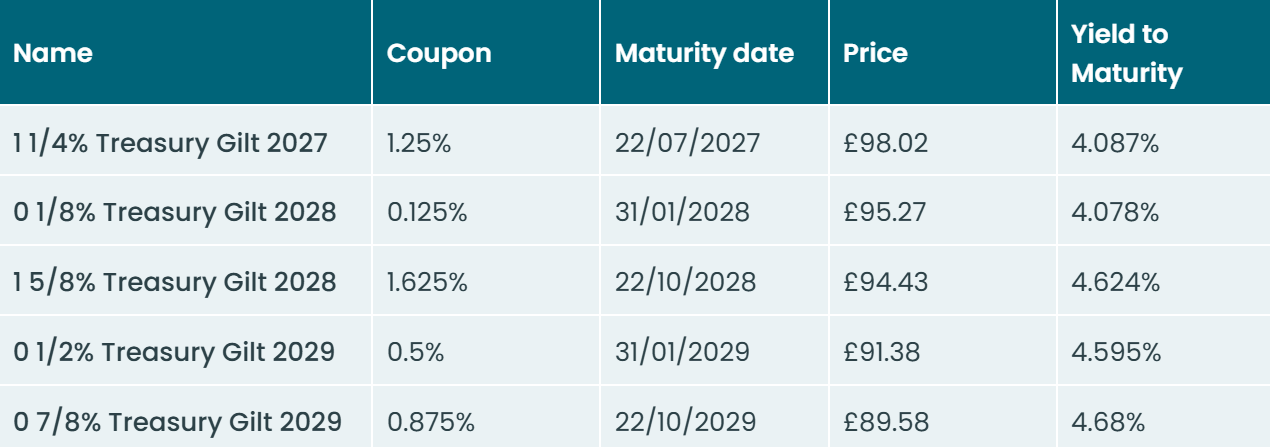
Indicative prices and yields supplied for this article. These are subject to verification against live market quotations before publication. Prices exclude accrued interest and dealing costs.
Take the final gilt in this table, maturing in October 2029.
At a price of around £89.58, you're paying less than £90 for something that will repay £100 in just under three years.
You'll also receive annual interest of 0.875%, based on the £100 nominal value.
The majority of your return therefore comes not from the coupon, but from the difference between your purchase price and the £100 redemption value.
And that difference is exempt from CGT.
The result is a potentially attractive after-tax return, even though the gilt's coupon is less than 1%.
What changed in the Budget?
Last week's Budget made this tax advantage more valuable.
The government confirmed that income tax on savings income will increase by four percentage points from current levels, with effect from 6 April 2027.
The new rates will be:
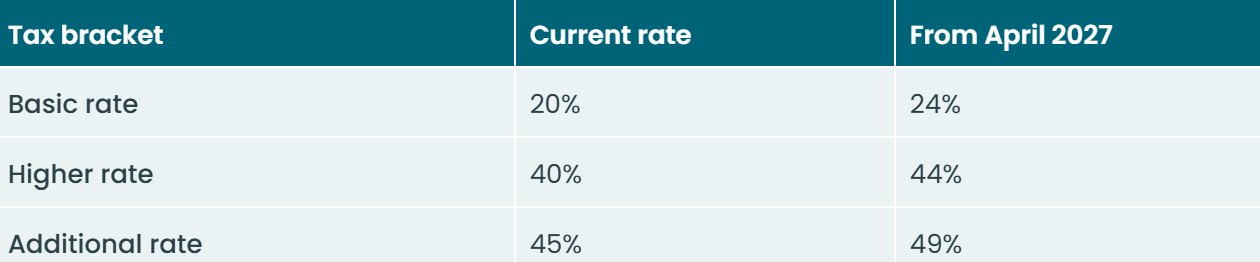
This represents a further two percentage point increase on top of the two percentage points previously announced.
For those holding substantial cash balances outside ISAs and pensions, the impact could be significant.
Take an additional rate taxpayer earning 4.5% on £100,000 in a conventional savings account.
That's £4,500 of annual interest.
Under the current rules, they'll pay £2,025 in tax, leaving £2,475, equivalent to a net return of 2.475%.
From next April, the tax bill rises to £2,205, leaving just £2,295, or 2.3% after tax.
Assuming inflation of say 3%, that implies a negative ‘real’ return.
Cash and gilts are affected very differently by this change.
With a conventional savings account, the tax increase applies to all taxable interest.
With a low-coupon gilt, it applies only to the relatively small coupon payments. The capital gain remains exempt from CGT.
Worked example
Here’s a worked example to bring this to life.
Charlie is an additional rate taxpayer with approximately £90,000 of surplus cash, held outside ISAs and pensions.
He doesn't expect to need this money for the next three years and wants to earn a reasonable return without taking significant investment risk.
Rather than leaving the money in a conventional savings account, he decides to buy £100,000 nominal of the 0.875% Treasury Gilt maturing on 22 October 2029.
Assuming a purchase price of £89.55 per £100 nominal, his position looks like this:
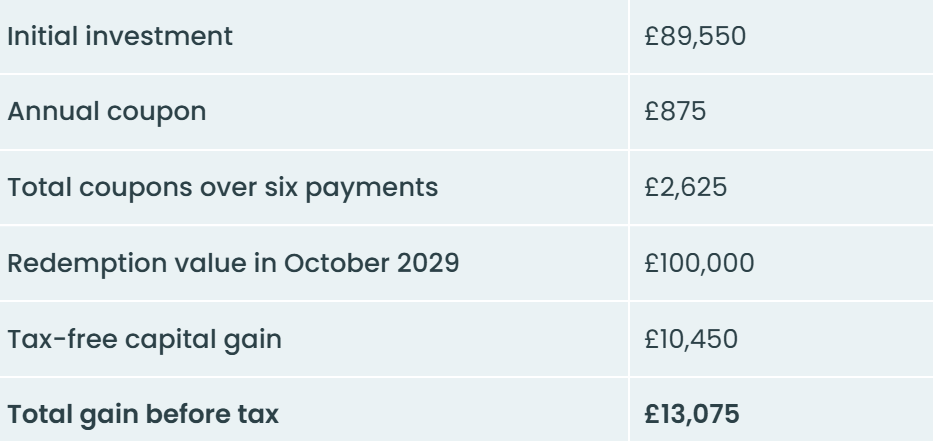
The important distinction is how that £13,075 gain is taxed.
The £10,450 capital gain is exempt from CGT.
Only the £2,625 of coupon income is subject to income tax.
Assuming the first coupon is taxed at 45%, with the subsequent five taxed at 49%, Charlie's total income tax liability is approximately £1,269.
That leaves him with a net profit of around £11,806, of which almost 90% is attributable to the tax-free capital gain.
Based on an investment of £89,550 over approximately three years, that's an after-tax annualised return of around 4.3%.
When investing, your capital is at risk. The value of your investment (and any income from it) can go down as well as up, and you may get back less than you invested. These figures are for illustrative purposes only, exclude dealing costs and are not guaranteed.
How does this compare with cash?
To achieve the same 4.3% after-tax return from a conventional savings account, an additional rate taxpayer would need to earn a gross interest rate of approximately 8.4%, assuming all interest is taxable at the new 49% rate. That's almost double the illustrative 4.5% savings rate used earlier.
The equivalent rate for a higher rate taxpayer (44%) is 7.7%, and for a basic-rate taxpayer (24%) it’s 5.7%.
The comparison illustrates why low-coupon gilts can be such a powerful tax-planning tool.
The figures above are illustrative and approximate. Actual returns will depend on the purchase date, accrued interest, dealing costs, coupon entitlements, tax treatment and the precise holding period.
The downsides
Of course, gilts aren't a ‘free lunch’.
There are several important drawbacks to consider.
1. You may lose money if you sell early
Whilst the redemption value is fixed, the market price isn't. If interest rate expectations rise after you've purchased a gilt, its market price will generally fall.
This can be significant, particularly for longer-dated gilts.
The pull-to-par mechanism becomes increasingly influential as maturity approaches, but prices don't move in a straight line.
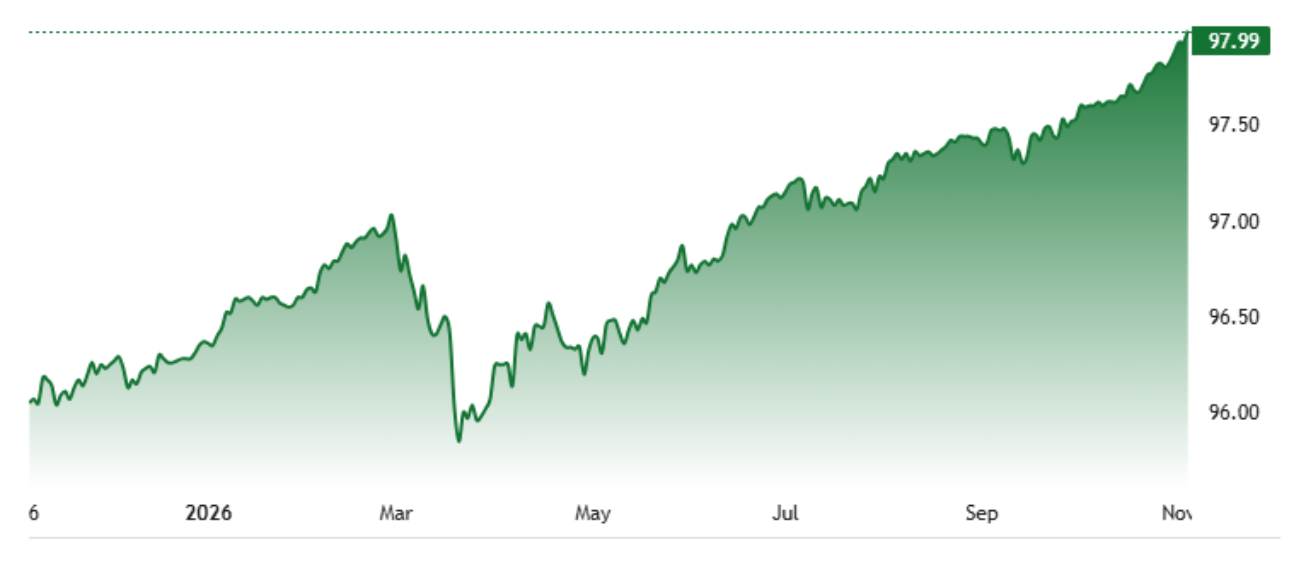
The chart above illustrates this. It shows the price history for the 1 1/4% Treasury Gilt 2027 (the first gilt in the earlier table).
Despite the gilt moving towards its £100 redemption value, there have been periods of considerable volatility along the way.
This is an important distinction versus a conventional savings account, where your balance doesn't fluctuate in response to market movements.
2. Reinvestment risk
When the gilt matures, you'll need to decide what to do with the proceeds.
If interest rates have fallen by then, you may struggle to reinvest the money at a similarly attractive yield.
3. Gilts aren't the same as gilt funds
The tax advantage described above applies to directly held gilts.
A gilt fund is a different proposition. Its underlying bonds are managed collectively, and the tax treatment of your investment depends on the fund structure and account in which it is held.
You shouldn't assume that buying a gilt fund will deliver the same tax advantages as holding individual gilts.
4. Default risk
Gilts are backed by the UK government, making the risk of default extremely low. Importantly, the UK government has always honoured its repayment obligations on gilts to date.
Nevertheless, this does not mean the risk is entirely eliminated. Past experience is reassuring, but it cannot guarantee that the government will always meet its obligations in the future.
Who might this suit?
Generally speaking, short-dated, low-coupon gilts are worth considering if you:
Are a higher or additional rate taxpayer with surplus cash held outside ISAs and pensions.
Have a known future expense, such as school fees, a tax bill or a house purchase, and can match the gilt's maturity date to when you'll need the money.
Are comfortable holding the gilt until maturity, rather than needing instant access to the funds.
For those with substantial cash reserves, a combination of instant-access savings and a ladder of short-dated gilts can work particularly well.
The former provides immediate liquidity; the latter offers the potential for a superior after-tax return on money that isn't needed straightaway.
Final thoughts
With gilt yields having risen and the tax on savings income set to increase from April 2027, short-dated, low-coupon gilts are becoming an increasingly attractive option for higher and additional rate taxpayers.
If you'd like to explore whether gilts might be appropriate for your circumstances, or simply want to chat through how they work, please let me know.
Happy Thursday.
Kind regards,
George
Referrals Welcome
Our business grows mainly through personal recommendations. If you know someone—whether a friend, family member or colleague—who might benefit from financial planning, we’d be grateful if you could share my details with them. Alternatively, you can pass their details on to me, and I’ll be happy to reach out.
Regulatory Information
Blincoe Financial Planning Limited is an appointed representative of Sense Network Ltd, which is authorised and regulated by the Financial Conduct Authority. Registered in England & Wales (No. 14569306). Registered Office: Star Lodge, Montpellier Drive, Cheltenham, GL50 1TY.
Important Disclaimer
This blog is for general information only and is intended for retail clients. It does not constitute financial or tax advice, nor is it an offer to buy or sell any specific investment. Since I don’t know your personal financial situation, you should not rely on this content as tailored advice. While we aim to provide accurate and up-to-date information, we cannot guarantee that all details remain correct over time. We are not responsible for any losses resulting from actions taken based on this blog’s content.