

(image created by AI; article written by me)
By George Taylor, CFA
Published: 19/11/2026
Why pension saving remains one of the most effective ways to build wealth
Pensions offer three core tax advantages: income tax relief on contributions, tax-free investment growth and up to 25% tax-free withdrawals. Even with Inheritance Tax applying to most unused pensions from April 2027, the maths remains compelling, with a £10,000 contribution costing an additional-rate taxpayer just £5,500.
This week, we're going back to basics and looking at the tax benefits of pensions.
This isn't just an excuse to crowbar an Oasis reference into a financial planning article. It's prompted by a worrying trend I'm increasingly witnessing: a reluctance to save into pensions for fear of what the government might do to them in the future.
This is entirely understandable. Successive governments have spent years tinkering with pension legislation, moving the goalposts and creating uncertainty. The mainstream media hardly help either, with annual doom-mongering about potential cuts to pension tax relief and tax-free cash entitlements, particularly in the run-up to each Budget.
The unfortunate consequence is that some people are turning their backs on pension saving altogether.
I'm also hearing another familiar argument, particularly from business owners: "My business is my pension."
Perhaps. But relying entirely on the future sale of a business to fund retirement is a risky strategy. Businesses can fail, valuations can disappoint and finding a buyer isn't always straightforward.
We'll return to business owners next week, when we'll explore the considerable tax advantages of directing company profits into pensions through employer contributions.
For now, let's remind ourselves why pensions remain one of the most attractive ways to build long-term wealth.
A pension is a long-term investment and funds are not normally accessible until 55 (rising to 57 from April 2028). When investing via a pension, your capital is at risk. The fund value may fluctuate and can go down, which would have an impact on the level of pension benefits available. Your pension income could also be affected by the interest rates at the time you take your benefits.
Pension magic
For most people, pensions are the most tax-efficient way to build wealth.
That’s thanks to a ‘triple-whammy’of tax advantages:
Tax relief on contributions. Money paid into a pension benefits from Income Tax relief, potentially at your highest marginal rate.
Tax-free investment growth. Investments held within a pension are generally free from UK Income Tax on investment income and Capital Gains Tax on realised gains.
Tax-free withdrawals. When you eventually access your pension, you can normally take up to 25% of the funds tax-free, subject to a maximum of £268,275 for most people. Those with certain protections from the old Lifetime Allowance rules may be entitled to more.
Until recently, there was a fourth advantage: pensions generally sat outside your estate for Inheritance Tax purposes. Unfortunately, this is changing. From 6 April 2027, most unused pension funds will be brought within the scope of Inheritance Tax.
Nevertheless, the original three benefits remain incredibly valuable.
How pension tax relief works
There are two common ways to receive tax relief on pension contributions.
1. Through payroll (net pay arrangement)
Contributions are deducted from your gross salary before Income Tax is calculated, meaning the tax relief is effectively immediate.
2. Personal contributions (relief at source)
You contribute from post-tax income, and your pension provider automatically claims basic-rate tax relief from HMRC.
For example, you pay £8,000 and HMRC adds £2,000, giving you £10,000 in your pension.
Higher and additional-rate taxpayers can claim further relief through Self Assessment or, where eligible, by notifying HMRC through its online service.
The ultimate Income Tax benefit is generally the same, although personal contributions can create a cashflow disadvantage, as additional tax relief must be reclaimed separately.
Where the magic happens
Consider a £10,000 gross pension contribution.
The effective net cost depends on your marginal rate of Income Tax:
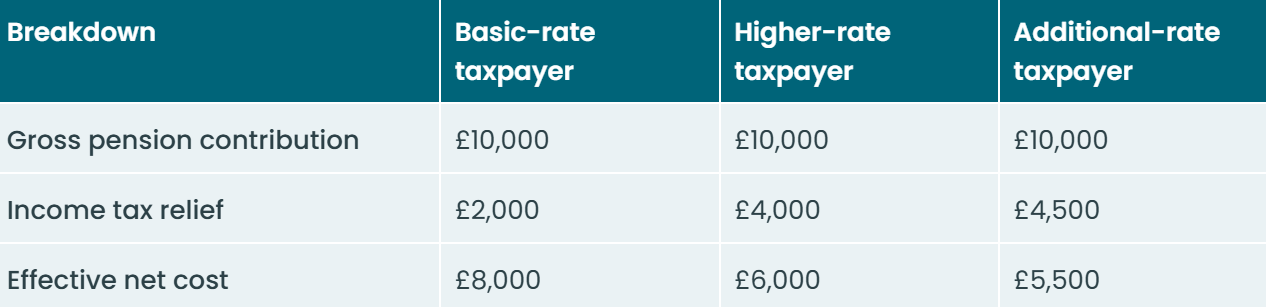
That's a considerable incentive, particularly for higher and additional-rate taxpayers, where the effective net cost of contributing £1 to your pension is just 60p and 55p respectively.
And this is why I find the growing reluctance to save into pensions so concerning. The tax advantages aren't marginal. As the following example demonstrates, they can be enormous, even before accounting for investment growth.
Worked example: Turning £5,500 into £8,500
Let's assume you're an additional-rate taxpayer today, receiving 45% Income Tax relief on your pension contributions.
You contribute £10,000 gross to your pension, at a net cost of just £5,500.
Fast-forward to retirement. For simplicity, we'll ignore investment growth and assume your pension remains worth £10,000.
You withdraw the money as follows:
£2,500 (25%) is taken tax-free.
The remaining £7,500 is taxed at the basic rate of Income Tax (20%), leaving £6,000.
Combined, that's £8,500 in your pocket, from an original net investment of just £5,500.
That's an effective gain of 55%, courtesy of the tax system alone.
And that's before you've earned a penny of investment growth.
The pension tax sweet spot
Admittedly, our example represents something of a best-case scenario: receiving 45% tax relief on contributions, taking 25% tax-free and paying just 20% Income Tax on withdrawals.
It's the ultimate ‘Masterplan’ of pension tax planning: maximising tax relief on the way in while minimising tax on the way out.
But the benefits extend well beyond this ideal scenario.
Chart 1: With 25% tax-free cash entitlement
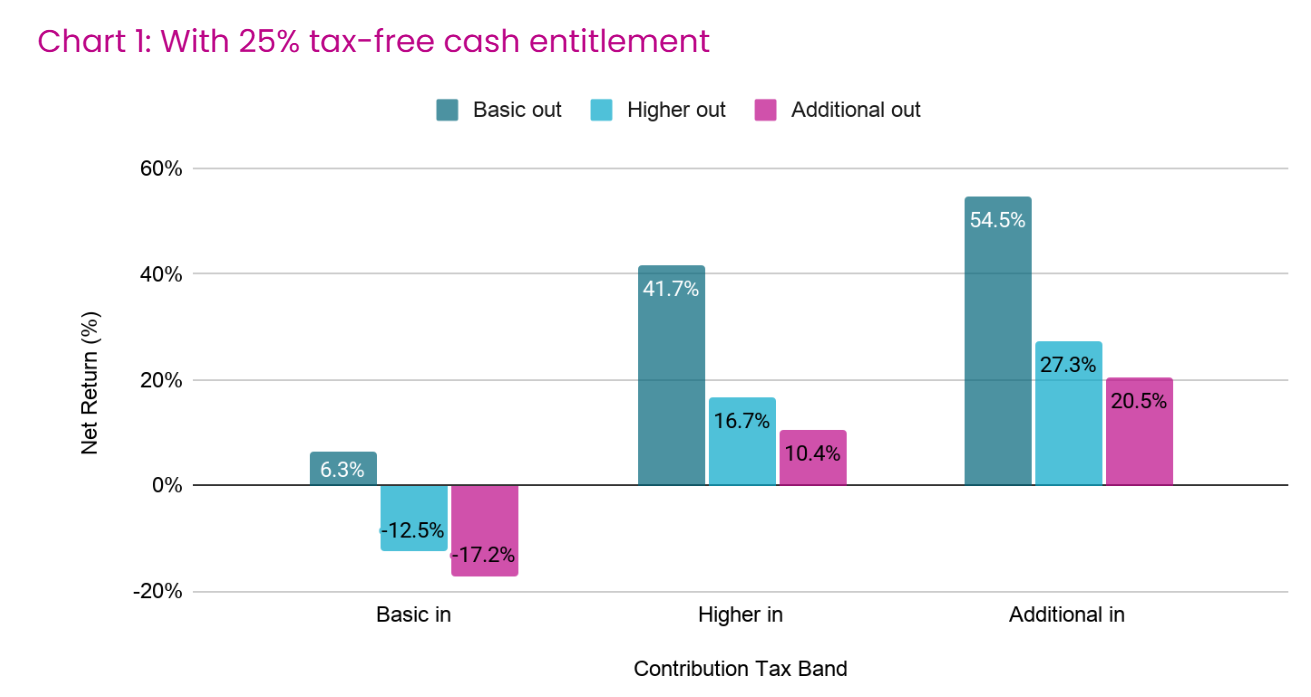
The first chart compares the effective return from pension tax relief across different combinations of tax rates on contributions (in) and withdrawals (out).
Our example above is the highest bar: Additional in / Basic out, delivering a 54.5% uplift.
But the important takeaway is that pensions remain attractive across most combinations of tax rates.
Even receiving 40% relief on contributions and paying 40% on withdrawals delivers a 16.7% uplift, thanks entirely to the tax-free cash entitlement.
In fact, provided you can take 25% tax-free, the maths remain favourable in almost every scenario illustrated. The exceptions are where you receive only basic-rate relief on contributions but subsequently pay higher or additional-rate tax on withdrawals.
Chart 2: Without tax-free cash entitlement
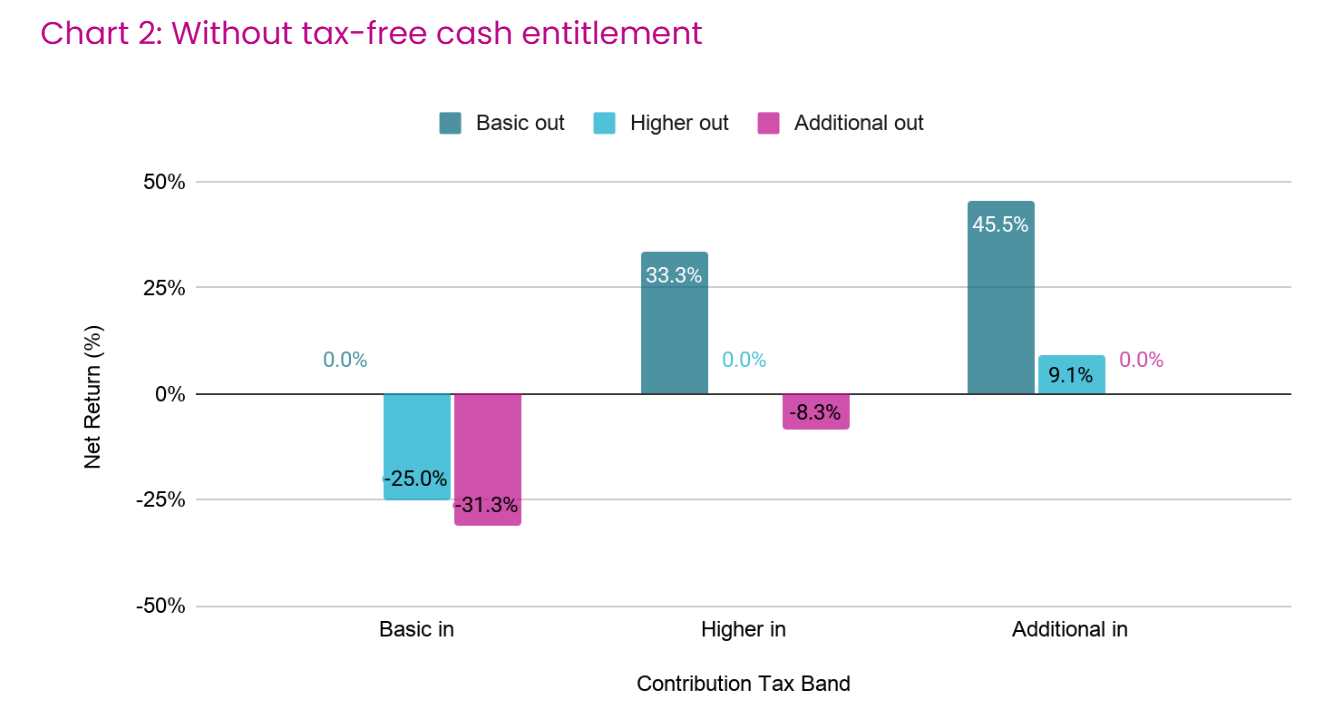
The picture changes somewhat once you've exhausted (or are set to exhaust on reasonable growth assumptions) your tax-free cash allowance, currently £268,275 for most people.
Here, the benefits depend much more heavily on the difference between your tax rate when contributing and withdrawing.
If those rates are identical, the tax advantage disappears. And if you pay more tax on withdrawals than you saved on contributions, the outcome can actually be negative.
Nevertheless, there are still substantial benefits where your retirement tax rate is lower. For example, receiving 45% relief today and paying 20% on withdrawals still delivers a 45.5% uplift.
The takeaway?
Pension contributions are generally most attractive when you receive higher-rate tax relief today and expect to pay less tax in retirement. And the 25% tax-free cash entitlement makes a considerable difference to the overall economics.
This is why retirement tax planning isn't simply about maximising contributions. It's also about considering how, and at what tax rate, you'll eventually withdraw the money.
What's the catch?
There is, of course, one significant drawback to pension saving: accessibility, or rather the lack of it.
Pension funds are generally inaccessible until the Normal Minimum Pension Age, currently 55 and rising to 57 from April 2028.
For someone in their twenties or thirties, that's a long time to have money locked away.
And this is precisely why pensions shouldn't necessarily be your only form of saving.
ISAs, for example, don't offer the same upfront tax relief but provide considerably greater flexibility, allowing you to access capital whenever required.
As ever, it's about finding the right balance. And as you approach retirement, the restrictions on pension access become progressively less relevant, while the immediate tax advantages remain.
Don't look back in anger
Which brings us back to where we started.
I understand the frustration surrounding pension legislation. Constant tinkering creates uncertainty, undermines confidence and makes long-term planning unnecessarily difficult.
And yes, future governments may change the rules again.
But we shouldn't let the possibility of future changes overshadow the considerable tax advantages available today.
Turning your back on pensions, particularly when you're entitled to 40% or 45% tax relief, could prove an expensive mistake.
A better approach is to maintain flexibility, diversify across different savings vehicles and adapt your strategy as the rules evolve.
After all, while we can't control what future governments might do, we can make the most of the opportunities available today.
Otherwise, you might just find yourself looking back in anger.
Next week: Part Two – Employer Pension Contributions: Champagne Supernova. We'll explore why employer pension contributions can be one of the most tax-efficient ways of extracting profits from a limited company.
Happy Thursday.
Kind regards,
George
Referrals Welcome
Our business grows mainly through personal recommendations. If you know someone—whether a friend, family member or colleague—who might benefit from financial planning, we’d be grateful if you could share my details with them. Alternatively, you can pass their details on to me, and I’ll be happy to reach out.
Regulatory Information
Blincoe Financial Planning Limited is an appointed representative of Sense Network Ltd, which is authorised and regulated by the Financial Conduct Authority. Registered in England & Wales (No. 14569306). Registered Office: Star Lodge, Montpellier Drive, Cheltenham, GL50 1TY.
Important Disclaimer
This blog is for general information only and is intended for retail clients. It does not constitute financial or tax advice, nor is it an offer to buy or sell any specific investment. Since I don’t know your personal financial situation, you should not rely on this content as tailored advice. While we aim to provide accurate and up-to-date information, we cannot guarantee that all details remain correct over time. We are not responsible for any losses resulting from actions taken based on this blog’s content.