
UK Budget 2026: Seven Key Changes and What They Mean for Your Financial Plan

(image created by AI; article written by me)
By George Taylor, CFA
Published: 29/10/2026
Seven changes worth knowing about, and what we make of them
From April 2027, income tax on savings rises by 4 percentage points - hitting additional-rate taxpayers with a 49% rate on interest outside ISAs - while Business Asset Disposal Relief is halved and rental income tax increases further. The October 2026 Budget also brought a welcome U-turn on Cash ISA cuts and reforms to the triple lock and Lifetime ISA.
After two blockbuster Budgets in the previous two years, the relative lack of noise in the run-up to this one suggested a much tamer affair. And so it proved.
That said, tucked away in the detail are several changes worth paying attention to. In this week's blog, we highlight seven key announcements, exploring what they mean from a financial planning perspective, who stands to benefit, and who might lose out.
1. State Pension reform: from triple lock to adjusted triple lock
Announced ahead of the Budget, this change has been widely misreported as the 'end of the triple lock', prompting predictable warnings about pension poverty. The reality is less dramatic.
Under the current system, the State Pension rises each year by the highest of:
2.5%,
CPI inflation, measured over the 12 months to the previous September
Average earnings growth, measured over the May–July period compared with the same three months a year earlier (including bonuses)
The new adjusted triple lock retains the 2.5% and inflation guarantees, but replaces the annual earnings link with a longer-term adjustment to ensure the State Pension doesn't fall behind earnings over time.
Crucially, this removes the ratcheting effect of the existing system. For example, if earnings fall by 5% one year, then recover by 5.26% the next, they're back where they started. Yet under the current triple lock, the State Pension would rise in both years (by at least 2.5% in the first, then 5.26% in the second).
This ratcheting makes the State Pension increasingly expensive relative to earnings.
In our view, this is a welcome, if imperfect, reform. The Government estimates annual savings of around £15 billion by 2039–40 (roughly £11 billion in today's money). The Institute for Fiscal Studies cautions that the actual savings are highly uncertain, potentially ranging from £4 billion to £20 billion, depending on earnings volatility (full article here).
2. Lifetime ISAs: out with the new, in with the old
Another Budget, another shake-up of the ISA regime for first-time buyers.
First came the Help to Buy ISA, followed by the Lifetime ISA (LISA). Now we're getting a First Time Buyer ISA (FTB ISA), due to replace the LISA for new savers from April 2029.
Interestingly, the new scheme more closely resembles the original Help to Buy ISA, with the government bonus paid at the point of property purchase, rather than as contributions are made, and a cap on the maximum bonus available.
The key announcements are:
New FTB ISA from April 2029: Offering a 25% government bonus on the account balance when used towards a qualifying first home, capped at £20,000.
Existing LISAs protected: Savers can continue contributing under the existing rules, including the £4,000 annual limit and 25% government bonus. Crucially, they can still withdraw their savings tax-free and charge-free from age 60.
Withdrawal penalty reduced immediately: From 29 October 2026, first-time buyers purchasing above the £450,000 property limit will face a 20% LISA withdrawal charge, rather than 25%. This effectively removes the government bonus without penalising their own savings. Other unauthorised withdrawals remain subject to the full 25% charge.
How do the two ISAs compare?
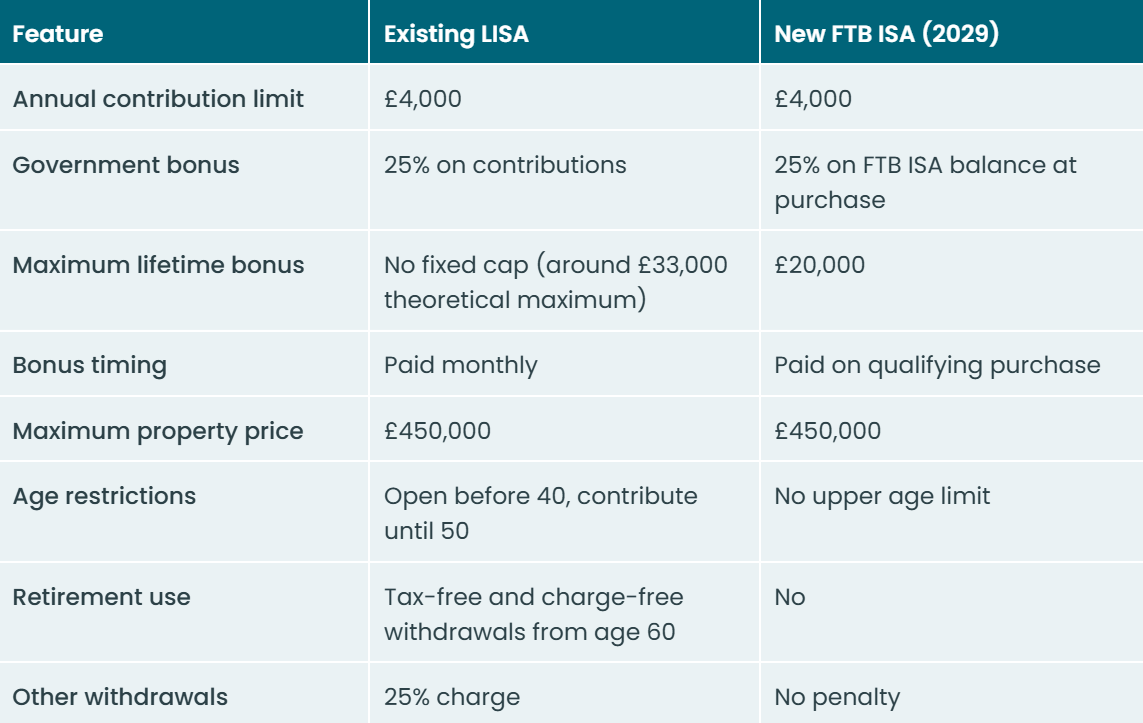
For first-time buyers purchasing below £450,000, the two schemes offer broadly similar incentives.
The more significant difference is flexibility.
The LISA doubles as a retirement savings vehicle, with the 25% government bonus and tax-free, charge-free withdrawals from age 60 making it particularly attractive to basic-rate taxpayers and those restricted by the tapered pension annual allowance.
Under the new rules, first-time buyers purchasing above £450,000 are also no worse off with a LISA. The reduced 20% withdrawal charge simply claws back the government bonus, just as the new FTB ISA would withhold it.
The remaining drawback is accessing LISA savings early for anything other than a first-home purchase. These withdrawals still incur a 25% charge, effectively clawing back the government bonus and penalising savers with an additional 6.25% charge. With the new FTB ISA, savers can withdraw their money without penalty, but simply won't receive the government bonus.
Our verdict
Existing LISA holders are the big winners, particularly those using them for retirement savings. They can continue contributing and enjoying benefits that will no longer be available to new savers from April 2029.
First-time buyers considering properties above £450,000 also benefit immediately, with the removal of the effective withdrawal penalty making LISAs considerably less risky.
For those eligible to open a LISA before April 2029, it's certainly worth considering while the opportunity remains.
3. Business Asset Disposal Relief: the limit is halved
Business Asset Disposal Relief (BADR, formerly Entrepreneurs’ Relief) gives business owners a reduced 18% Capital Gains Tax (CGT) rate on qualifying business disposals.
From April 2027, the lifetime limit falls from £1m to £500,000. Gains above the limit are taxed at standard CGT rates—24% for a higher-rate taxpayer.
By way of an example (assumes higher rate tax, no annual exempt amount):
Helen sells her company in 2027/28 with a qualifying gain of £1m.
Under the old £1m limit, the whole gain is taxed at 18%: £180,000.
Under the new £500,000 limit, £500,000 is taxed at 18% (£90,000) and £500,000 at 24% (£120,000): £210,000.
Extra tax: £30,000.
As the change does not take effect until April 2027, owners considering a sale may wish to bring it forward. Spreading qualifying shareholdings between spouses may also make better use of the relief, though this needs accountant advice.
4. A new Pension Tax Allowance for lower-income retirees
With the full new State Pension (est. £13,036 p.a. from next year) set to exceed the frozen personal allowance (£12,570), some pensioners would soon face income tax even if the State Pension were their only income.
To address this, the Government is introducing a Pension Tax Allowance from April 2027, ensuring those over State Pension age with total income no higher than the full new State Pension pay no income tax.
The relief is worth a modest £93 a year at most and is tapered away for those with slightly higher incomes. It will initially apply for three tax years, until April 2030.
5. (Yet) More tax on landlords
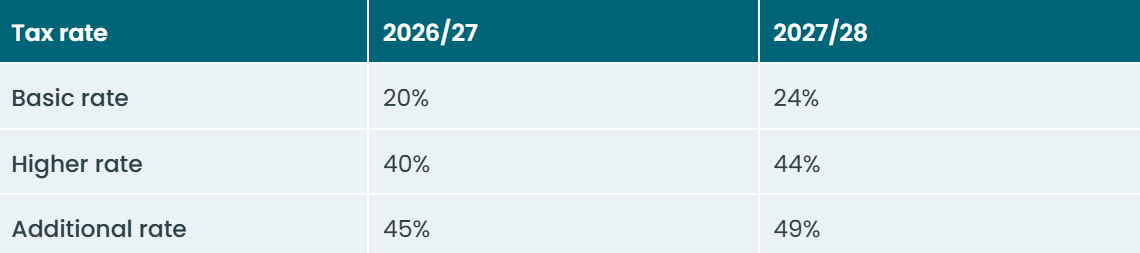
From April 2027, an additional 2% income tax will apply to rental profits in England, Wales and Northern Ireland, taking the rates to 24%, 44% and 49% for basic, higher and additional-rate taxpayers respectively.
Yet more bad news for landlords, following successive tax increases, the restriction of mortgage interest relief to 20%, and the recent Renters' Rights Act.
That said, the contrarian in me wonders whether those who stick it out might ultimately benefit. As more and more landlords sell up and rental supply tightens, those remaining could enjoy greater pricing power, with higher rents potentially offsetting some (or all) of the additional tax. Maybe.
What about holding property through a limited company? Companies pay corporation tax rather than income tax on rental profits, avoiding the new rates. However, extracting profits as dividends introduces another layer of taxation, while transferring existing properties into a company can trigger Capital Gains Tax. My suspicion is that the benefits will be marginal for many, but this is one for a specialist property tax adviser.
Our verdict
Landlords holding property personally lose out, while those operating through companies may be relatively better placed. Those who stay the course could also benefit from tighter supply and higher rents, although that's far from guaranteed.
6. The Cash ISA U-turn
Last year's proposal to cut the Cash ISA allowance to £12,000 for under-65s from April 2027 has been scrapped. A welcome U-turn, with the full £20,000 allowance retained for everyone.
The proposed 22% tax on interest earned on uninvested cash within Stocks & Shares ISAs also appears to have been abandoned.
Both are welcome developments. The age-based allowance would have added unnecessary complexity, while taxing cash within investment ISAs would have created a significant administrative burden for platforms, potentially pushing up costs for investors.
We've long argued that the way to encourage more Britons to invest is through better financial education and making the UK a more attractive place to invest. Complicating the ISA rules achieves neither.
7. Higher tax on savings income
This was the sneaky one.
From April 2027, income tax on savings was already due to rise by 2 percentage points. Yesterday's Budget added another 2 percentage points, taking the total increase to 4 percentage points across the UK.
Cash savers: the big losers
Those holding significant cash savings outside ISAs will be hardest hit, particularly higher and additional-rate taxpayers, who will face tax rates of 44% and 49% respectively on interest above their available allowances.
This makes maximising ISA allowances more important than ever, alongside considering how savings are held between spouses.
For example, holding cash in the sole name of a lower-earning spouse, who may pay little or no tax on the interest, could be considerably more efficient than holding it jointly or in the name of an additional-rate taxpayer, who could lose almost half their interest to tax (49%).
The optimal arrangement will depend on each spouse's income, available allowances and ownership of the funds.
Gilts become more attractive
Low-coupon UK gilts also become more appealing. Gains on conventional gilts are exempt from Capital Gains Tax (CGT), meaning much of the return from buying below face value and holding to maturity can be tax-free. The coupon interest remains taxable, but this can represent a relatively small proportion of the overall return.
We'll be revisiting the mechanics of gilts in more detail in an upcoming blog.
Investment bonds versus GIAs
The increase also affects investment bonds, as chargeable event gains are taxed as savings income. With dividend tax rates and CGT unchanged, this arguably tilts the balance further towards General Investment Accounts (GIAs), where capital gains are taxed at 18% or 24%. Bonds retain valuable tax-planning advantages, but their relative appeal has diminished, particularly for basic-rate taxpayers.
Our verdict
Non-ISA cash savers are the clear losers, particularly higher earners. ISAs, pensions and low-coupon gilts become relatively more attractive, while GIAs may gain ground against investment bonds. Above all, how and where you hold your savings matters more than ever.
As one door closes, another one opens
We've moved from stealth taxes (frozen allowances dragging more people into higher tax bands) to tax creep, with higher rates on savings, property income and dividends.
Against this backdrop, ISAs and pensions become more valuable than ever. A few practical takeaways:
Maximise ISA allowances. The £20,000 annual allowance remains unchanged, with the Cash ISA U-turn preserving flexibility.
Keep making use of pensions. The main allowances and tax reliefs remain intact.
Consider low-coupon gilts. Particularly for higher-rate taxpayers holding significant cash outside ISAs.
Make use of spousal allowances. Holding savings and investments in the name of a lower-earning spouse can offer meaningful tax savings.
Review investment structures. The higher savings tax rates may make GIAs relatively more attractive than investment bonds.
Business owners, plan ahead. The changes to Business Asset Disposal Relief (BADR) warrant particular attention.
A slightly disappointing Budget
While a relatively quiet Budget was expected, I came away a little disappointed by the lack of more meaningful reform.
The UK's public finances remain under considerable pressure, and there is arguably a case for bolder decisions on both taxation and government spending. Instead, we continue to see incremental tax increases and growing complexity, without much progress towards a simpler, more sustainable system.
One concern is the so-called 'moron premium', the additional yield investors demand to lend to the UK relative to other developed economies. Higher gilt yields increase government borrowing costs and can feed through to higher mortgage rates, putting further pressure on household finances.
There are no easy answers, and the trade-offs between taxation, spending and borrowing are considerable. But a more credible long-term approach to the public finances could potentially reduce borrowing costs, benefiting households and the wider economy.
Conclusion
A quiet Budget, but not without consequences.
The State Pension reforms are less dramatic than the headlines suggest, while existing LISA holders and Cash ISA savers have reason to be pleased. Business owners and landlords face further challenges, and the increase in savings tax rates will hit those holding significant cash outside tax wrappers.
The overarching message? Making full use of ISAs, pensions and available allowances, while reviewing how savings and investments are structured, can make a meaningful difference over time.
The Financial Conduct Authority does not regulate tax advice. Levels, bases, and reliefs from taxation may be subject to change, and their value depends on the individual circumstances of the investor. When investing, your capital is at risk. The value of your investment (and any income from them) can go down as well as up, and you may get back less than you invested, particularly when investing for a short timeframe. Investments should be considered over the longer term and should fit in with your overall attitude to risk and financial circumstances.
Happy Thursday.
Kind regards,
George
Referrals Welcome
Our business grows mainly through personal recommendations. If you know someone—whether a friend, family member or colleague—who might benefit from financial planning, we’d be grateful if you could share my details with them. Alternatively, you can pass their details on to me, and I’ll be happy to reach out.
Regulatory Information
Blincoe Financial Planning Limited is an appointed representative of Sense Network Ltd, which is authorised and regulated by the Financial Conduct Authority. Registered in England & Wales (No. 14569306). Registered Office: Star Lodge, Montpellier Drive, Cheltenham, GL50 1TY.
Important Disclaimer
This blog is for general information only and is intended for retail clients. It does not constitute financial or tax advice, nor is it an offer to buy or sell any specific investment. Since I don’t know your personal financial situation, you should not rely on this content as tailored advice. While we aim to provide accurate and up-to-date information, we cannot guarantee that all details remain correct over time. We are not responsible for any losses resulting from actions taken based on this blog’s content.
Start here
Wondering if we'd be a good fit?
Answer a few short questions about your situation. If it looks like we can help, you can book an introductory call with one of our planners at the end.
See if we're a good fitTwo minutes. No obligation.