
IHT Gifting Exemptions Explained: How to Give Away Far More Than £3,000 a Year Free of Inheritance Tax

(image created by AI; article written by me)
By George Taylor, CFA
Published: 15/10/2026
There's More Than the £3,000 Allowance
IHT-exempt gifting is far more powerful than the £3,000 annual allowance suggests. The Normal Expenditure out of Income exemption allows potentially unlimited regular gifts from surplus income, immediately outside your estate - and for retirees with pension and investment assets, a structured gifting strategy could transfer £660,000 to family over ten years with £264,000 in IHT savings.
A couple of weeks ago, we explored the various ways to reduce or provide for a potential Inheritance Tax (IHT) liability. Broadly speaking, there are three approaches: gift it, invest it or insure it.
This week, we're taking a closer look at the first of these, specifically the various types of outright gifts that qualify for an immediate exemption from IHT. No seven-year waiting period, no lingering IHT liability. Provided the relevant conditions are met, these gifts are outside your estate for IHT purposes from day one.
Most people are familiar with the £3,000 annual gifting exemption (per person). Far fewer are aware of the other exemptions available, including wedding gifts, small gifts, charitable donations and, perhaps most importantly, regular gifts out of surplus income (formally known as the Normal Expenditure out of Income exemption).
As a result, many people underestimate just how much they can give away without creating a potential IHT liability.
While some of these allowances may seem relatively modest in isolation, their value can build considerably over time. And for those with substantial surplus income, the opportunities can be much greater, particularly where we can deliberately generate additional income, perhaps through pension withdrawals, to support a regular gifting strategy.
Used effectively, these exemptions can transfer significant wealth to the next generation, entirely free of IHT, without ever starting the seven-year clock.
The Financial Conduct Authority does not regulate Estate and Inheritance Tax Planning. Inheritance Tax thresholds depend on your individual circumstances and may change in the future.
IHT on Direct Gifts
Generally speaking, larger gifts to individuals are classed as Potentially Exempt Transfers (PETs). There's no immediate IHT to pay, but the person making the gift (the donor) must survive seven years for the gift to become fully exempt from IHT.
The exemptions below work differently. Provided the relevant conditions are met, gifts qualify for immediate exemption from IHT. No seven-year waiting period, no potential tax liability hanging over the gift.
1. Annual exemption
Everyone can give away up to £3,000 per tax year without creating a potential IHT liability. For a married couple, that's £6,000 between them.
Any unused allowance can be carried forward, but only for one tax year, with the current year's allowance used first.
So, if you didn't use last year's allowance, you could give away up to £6,000 this year (£12,000 for a couple), immediately exempt from IHT.
2. Small gifts
You can give up to £250 per recipient, per tax year, to as many people as you like. Birthday and Christmas presents for grandchildren, godchildren, nieces and nephews are obvious examples.
There's one important restriction: the small gifts exemption cannot be combined with the annual exemption (or another gifting exemption) for the same recipient.
However, you can use the different exemptions for different recipients, which creates some useful planning opportunities.
Take a married couple with three adult children and six grandchildren. Between them, they could give away:
£6,000 to their adult children, using both £3,000 annual exemptions.
£1,500 to their six grandchildren, using the £250 small gifts exemption for each grandchild.
That's £7,500 gifted each year, immediately exempt from IHT, without starting the seven-year clock.
Assuming these gifts would otherwise have formed part of an estate subject to IHT at 40%, that's a potential £3,000 IHT saving each year.
3. Gifts in consideration of marriage or civil partnership
Gifts made in consideration of a wedding or civil partnership qualify for an additional exemption:
£5,000 from a parent
£2,500 from a grandparent or great-grandparent
£1,000 from anyone else
Usefully, these exemptions can be combined with the annual exemption. A parent could therefore give their child £8,000 immediately free of IHT.
4. Charitable donations
Gifts to UK registered charities (and qualifying political parties) are exempt with no upper limit, whether made during your lifetime or on death.
5. Normal expenditure out of income
Last, and arguably the most powerful (and often overlooked) exemption, is the Normal Expenditure out of Income exemption. This allows you to give away potentially 100% of your surplus income, immediately free of IHT. There's no monetary ceiling and no seven-year rule.
To qualify under this exemption, gifts must meet three conditions:
Regularity: Gifts must form part of your normal expenditure, establishing a habitual pattern. This doesn't necessarily require years of history. A clear commitment to making regular gifts, supported by evidence and followed through in practice, can be sufficient.
Funded from income: The gifts must be made from income, rather than capital.
Maintaining your standard of living: After making the gifts, you must have sufficient income remaining to maintain your usual standard of living, without needing to draw on capital to cover normal expenditure.
What Counts as Income?
The definition of income is broader than many think. Alongside salary and pensions, it includes rental income, interest and dividends.
Importantly, income generated within ISAs and other investment portfolios can also qualify, even where it's automatically reinvested, provided it can be distinguished from capital growth.
For those with substantial pension pots, there may also be scope to generate additional income through drawdown or annuity purchase, potentially increasing the surplus available for regular, IHT-exempt gifts. The treatment of pension withdrawals does, however, depend on their nature.
A pension is a long-term investment and funds are not normally accessible until 55 (rising to 57 from April 2028). When investing via a pension, your capital is at risk. The fund value may fluctuate and can go down, which would have an impact on the level of pension benefits available.
Worked Example
The following example illustrates how these exemptions can work together to deliver substantial IHT savings over time, particularly the Normal Expenditure out of Income (NEOI) exemption.
Ben and Rose are both 72 and retired. Their financial position is as follows:
Defined Benefit pensions: £60,000 a year combined (£30,000 each), providing approximately £53,000 after tax.
Household expenditure: £41,000 a year.
Defined Contribution pensions: £500,000 combined (£250,000 each).
Stocks & Shares ISAs: £800,000 combined (£400,000 each).
They currently give away £3,000 each year, believing that their combined £6,000 annual gifting exemption is the maximum they can give away without triggering the seven-year rule.
In reality, they could potentially give away considerably more.
Step 1: Gift their surplus pension income
Ben and Rose receive around £53,000 a year after tax but spend only £41,000.
That leaves £12,000 of surplus income each year, which could be gifted under the NEOI exemption, provided they establish a regular pattern of giving.
Crucially, this is in addition to their combined £6,000 annual gifting exemptions.
Total potential IHT-exempt gifts: £18,000 a year.
Step 2: Make Use of their investment income
Their combined £800,000 ISA portfolios generate dividends of approximately 2% a year, equivalent to £16,000.
Although these dividends are currently reinvested, they are still income rather than capital growth. Subject to the necessary conditions and record-keeping, this income could also support regular gifts under the NEOI exemption.
That brings their potential annual gifting capacity to:
£18,000 + £16,000 = £34,000 a year.
Already, that's more than five times the amount they originally thought they could give away.
Step 3: Generate additional pension income
But they could potentially go further.
Ben and Rose also have £500,000 in Defined Contribution pensions, which they haven't yet needed to access.
This is particularly relevant given the forthcoming changes to pension taxation. From 6 April 2027, most unused pension funds will be brought within the scope of IHT on death.
For those dying after age 75, inherited pension withdrawals can also be subject to Income Tax in the hands of beneficiaries. This creates the potential for a ‘double death tax’: IHT on the pension fund, followed by Income Tax when beneficiaries withdraw the remaining funds.
One option Ben and Rose might consider is drawing an additional £20,000 each year from their respective pensions. This would keep their individual taxable incomes below the higher-rate threshold (under current England, Wales and Northern Ireland tax bands), meaning the additional withdrawals would be taxed at 20%.
Between them, that would generate:
£40,000 additional gross pension withdrawals.
£8,000 Income Tax.
£32,000 additional net income potentially available for gifting (assuming the other conditions are satisfied).
Putting it all together
Here’s what Ben and Rose’s annual gifting strategy could look like:
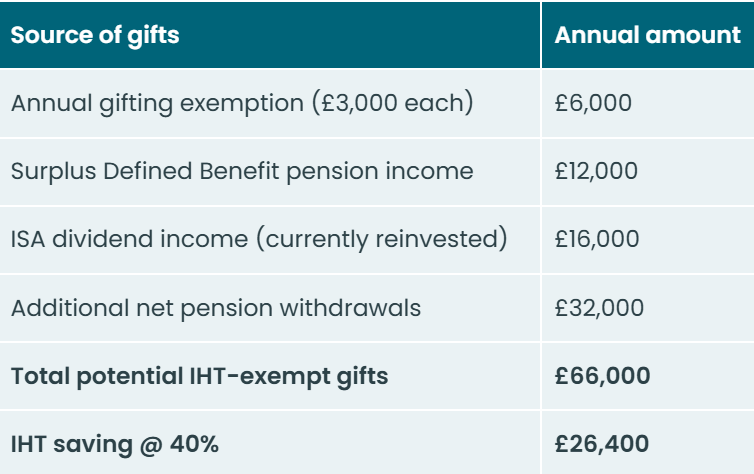
That's £60,000 more each year than they originally thought they could give away.
Assuming the gifts would otherwise have formed part of an estate subject to IHT at 40%, the potential saving is estimated at £26,400 each year.
And over ten years?
£660,000 transferred to their loved ones.
£264,000 in potential IHT savings.
All without relying on the seven-year rule, assuming the relevant exemptions are satisfied.
Of course, these figures are illustrative. The pension withdrawals would need careful consideration, including the Income Tax cost, the sustainability of their retirement income and whether the gifts genuinely qualify for exemption.
But the wider point remains: IHT-exempt gifting can be far more powerful than simply making use of the £3,000 annual allowance.
No complicated trust structures. No seven-year countdown. And perhaps best of all, Ben and Rose get to see their money put to good use by their loved ones during their own lifetimes.
Record Keeping
Good record-keeping is essential, particularly for the Normal Expenditure out of Income exemption.
It's generally your executors, rather than you, who must demonstrate that the gifts qualified, potentially many years later, when completing the IHT return (form IHT403).
The exemption is only as robust as the evidence you leave behind.
A local solicitor we work closely with recommends:
A formal note: Setting out your intention to make regular gifts, including amounts, recipients and frequency. This will sit alongside your will.
A gifting record: Recording the date, amount and recipient of each gift.
Standing orders: Where possible, to create a clear audit trail.
Annual income and expenditure records: Demonstrating that gifts came from surplus income without affecting your standard of living, supported by relevant bank, pension and investment statements.
Think of it as doing your executors' homework for them.
Final Thoughts
The smaller gifting exemptions are well worth making use of each year. But for many people, particularly retirees with substantial pension and investment assets, it's the Normal Expenditure out of Income exemption that can do the real heavy lifting.
And with most unused pension funds coming within the scope of IHT from April 2027, the opportunities to use pension income to support a wider gifting strategy are arguably more relevant than ever.
The key is to plan ahead, understand which exemptions are available, and, crucially, keep the records needed to support them.
As always, if you'd like to explore how these exemptions might apply to your own circumstances, do get in touch.
Happy Thursday.
Kind regards,
George
Referrals Welcome
Our business grows mainly through personal recommendations. If you know someone—whether a friend, family member or colleague—who might benefit from financial planning, we’d be grateful if you could share my details with them. Alternatively, you can pass their details on to me, and I’ll be happy to reach out.
Regulatory Information
Blincoe Financial Planning Limited is an appointed representative of Sense Network Ltd, which is authorised and regulated by the Financial Conduct Authority. Registered in England & Wales (No. 14569306). Registered Office: Star Lodge, Montpellier Drive, Cheltenham, GL50 1TY.
Important Disclaimer
This blog is for general information only and is intended for retail clients. It does not constitute financial or tax advice, nor is it an offer to buy or sell any specific investment. Since I don’t know your personal financial situation, you should not rely on this content as tailored advice. While we aim to provide accurate and up-to-date information, we cannot guarantee that all details remain correct over time. We are not responsible for any losses resulting from actions taken based on this blog’s content.
Start here
Wondering if we'd be a good fit?
Answer a few short questions about your situation. If it looks like we can help, you can book an introductory call with one of our planners at the end.
See if we're a good fitTwo minutes. No obligation.