

(image created by AI; article written by me)
By George Taylor, CFA
Published: 26/11/2026
Why your business should fund your pension, not ‘be’ your pension
For limited company directors, an employer pension contribution can be far more tax-efficient than dividends. In our worked example, £10,000 of company profit leaves a director with £4,722 after tax via dividends, but £8,500 via a pension (a basic-rate taxpayer taking 25% tax-free), around 80% more.
Last week, in Pensions: Don't look back in anger, we explored why pensions remain an incredibly attractive savings vehicle, despite successive governments' seemingly insatiable appetite for tinkering with pension legislation.
This week, continuing with our Oasis theme, we're turning our attention to employer pension contributions.
This is aimed primarily at limited company directors, for whom employer pension contributions can be an extremely effective tool not only for tax planning, but also for diversifying wealth and managing risk across their wider financial affairs.
A pension is a long-term investment and funds are not normally accessible until 55 (rising to 57 from April 2028). When investing via a pension, your capital is at risk. The fund value may fluctuate and can go down, which would have an impact on the level of pension benefits available. Your pension income could also be affected by the interest rates at the time you take your benefits.
The challenge of extracting profits
One of the frustrations of running a successful business is just how much tax you can incur in getting your hands on the profits you've worked so hard to generate.
For many limited company directors, the conventional approach is to draw a modest salary, supplemented by dividends.
Historically, this has been a relatively tax-efficient way of remunerating yourself. However, successive increases in corporation tax and dividend tax have made extracting profits in this way increasingly expensive.
And once you've exhausted your basic-rate income tax band, things become particularly painful.
A worked example
Consider a hypothetical limited company with two shareholder-directors.
The business is profitable, generating annual taxable profits of £175,000.
Each director draws an annual salary of £12,570, supplemented by dividends of £37,700, taking their total annual income to £50,270, thereby sitting just below the higher rate tax threshold.
The salary falls entirely within the Personal Allowance, meaning no income tax or employee National Insurance contributions are payable. Crucially, it also sits above the Lower Earnings Limit, enabling both directors to continue building their State Pension entitlement. Meanwhile, their dividend income is subject to tax at 10.75% (after allowing for the £500 tax-free Dividend Allowance), resulting in a tax charge of £4,000 each and annual net income of £46,270 each.
Having accounted for their personal expenditure and the working capital requirements of the business, the directors are looking to extract some additional profits.
Broadly speaking, they have two options:
Extract the profits as additional dividends.
Make employer pension contributions directly from the company into their respective pensions.
Let's consider the tax implications of each, using an incremental £10,000 of company profits.
Option 1: Dividends
Before the company can distribute its profits as dividends, it must first pay corporation tax.
Whilst the main rate of corporation tax is 25%, the effective marginal rate for a standalone company with profits between £50,000 and £250,000 is 26.5%, owing to the gradual withdrawal of corporation tax marginal relief.
In our example, this leaves £7,350 available for distribution.
The director then incurs higher-rate dividend tax at 35.75%.
Here's how the numbers stack up:
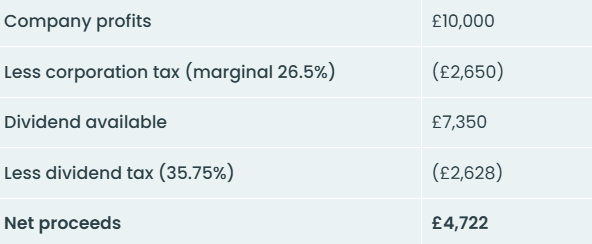
In other words, of the original £10,000 of company profits, the director retains less than half.
The combined effective rate of taxation is approximately 53%.
Option 2: Employer pension contribution
Alternatively, the company could make a £10,000 employer pension contribution directly into the director's pension.
Assuming the contribution qualifies as an allowable business expense (it must satisfy the ‘wholly and exclusively’ rules), it reduces the company's taxable profits accordingly.
The beauty of this approach is that the money goes straight from the company into the director's pension, without suffering any Corporation Tax, income tax, dividend tax or National Insurance contributions. The full £10,000 is invested for the director's future.
Of course, to make this a fair comparison, we also need to consider the tax payable ‘on the way out’, when the director eventually draws upon their pension in retirement.
Let's assume the director can withdraw 25% of their pension tax-free, with the remaining 75% subject to basic-rate income tax:
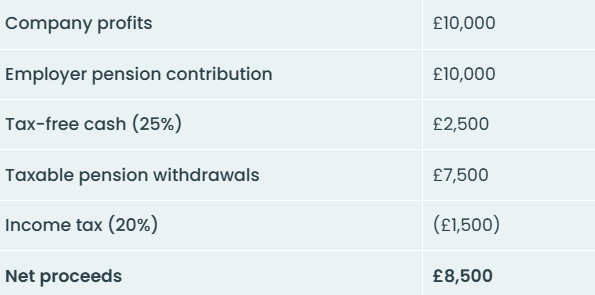
The combined effective rate of taxation is just 15%.
What's more, we've deliberately ignored any investment growth to keep the comparison simple. In reality, the full £10,000 could remain invested within the pension for many years, benefiting from investment growth largely free of UK income tax and Capital Gains Tax.
The ability to invest money that would otherwise have been lost to tax, and to benefit from the compounding of that money over many years, makes the pension route potentially even more compelling.
The power of employer pension contributions
Comparing the two outcomes side-by-side:
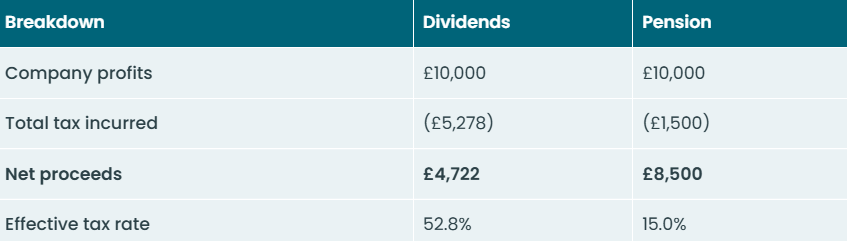
By opting for an employer pension contribution, the director ultimately retains approximately 80% more money.
What if you're a higher-rate taxpayer in retirement?
Of course, not everyone will be a basic-rate taxpayer in retirement. Nor will everyone have sufficient remaining tax-free cash entitlement.
But even under less favourable circumstances, the numbers remain compelling.
Using the same £10,000 employer pension contribution:
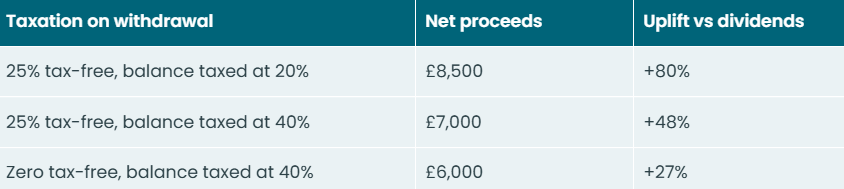
Even in the final scenario, where the director has exhausted their tax-free cash allowance and pays higher-rate income tax on every penny withdrawn, they still retain considerably more than had they extracted the profits as dividends in our example.
What's the catch?
The principal downside of this strategy is liquidity (or lack thereof).
By extracting profits as dividends, you're free to spend or invest that money as you see fit. By making an employer pension contribution, you're effectively locking that money away until you reach Minimum Pension Age (currently 55, rising to 57 from 6 April 2028 for most people).
Depending on your age, that could be several decades away.
So whilst employer pension contributions may be considerably more attractive from a tax planning perspective, they're not necessarily so from a liquidity perspective.
That said, one could turn this argument on its head and suggest that the inability to access your pension savings is one of its greatest strengths.
It instils a degree of savings discipline, removes the temptation to dip into your long-term investments and affords your money the time to benefit from the power of compounding within a highly tax-efficient environment.
As ever, it's about striking the right balance between meeting your financial needs today, retaining sufficient flexibility for the years ahead and building wealth for tomorrow.
"My business is my pension"
This is a phrase we regularly hear from business owners.
The premise is that at some point in the future there will be an exit, a significant capital event that will ultimately fund their retirement.
And that's a perfectly legitimate strategy. Indeed, for many business owners, the eventual sale of their business will be the single biggest financial event of their lifetime.
But it's also a very high-risk strategy.
And one could reasonably argue that it's now riskier than ever before.
Consider the pace at which artificial intelligence is developing. Whilst nobody knows precisely how this will play out, there is widespread recognition that AI has the potential to fundamentally disrupt entire industries, rendering some existing business models largely redundant. Whether the future proves to be utopian, dystopian or somewhere in between, one could reasonably argue that no business is entirely immune to this risk.
A business that is highly profitable today may look very different in ten years' time. And even if it continues to thrive, who's to say there will be a willing buyer, prepared to pay the valuation you're hoping to achieve, at precisely the point you want to retire?
This isn't intended to be pessimistic. It's simply an acknowledgement of the risks associated with having so much of your personal wealth tied up in a single business.
From business wealth to personal wealth
This is where employer pension contributions make sense beyond the mathematics of tax efficiency.
By systematically extracting surplus profits from your business and investing them within a pension, you're gradually diversifying your wealth.
Rather than continually accumulating wealth within a single privately owned company, you're building exposure to thousands of publicly listed companies, across different industries, geographies and economies (alongside bonds and other assets, where appropriate).
And if, in years to come, you do achieve a successful exit from your business, all the better. But your retirement is no longer entirely dependent on that outcome.
In our view, your business should be a vehicle for achieving financial independence, rather than something upon which your financial independence is entirely dependent.
Champagne Supernova
As with all things in financial planning, it's about striking the right balance.
There will inevitably be times when reinvesting profits into your own business represents the best use of that capital. Equally, you need to ensure that both you and your business retain sufficient liquidity, particularly given the restrictions on accessing pension savings before Minimum Pension Age.
But where your business is consistently generating profits surplus to your personal and business requirements, employer pension contributions offer a particularly compelling proposition.
Not only are you extracting wealth in an extraordinarily tax-efficient manner, but you're also reducing the concentration of risk within your wider financial affairs.
Rather than waiting for one potentially life-changing financial event, you're gradually converting the success of your business today into financial security for tomorrow.
Happy Thursday.
Kind regards,
George
Referrals Welcome
Our business grows mainly through personal recommendations. If you know someone—whether a friend, family member or colleague—who might benefit from financial planning, we’d be grateful if you could share my details with them. Alternatively, you can pass their details on to me, and I’ll be happy to reach out.
Regulatory Information
Blincoe Financial Planning Limited is an appointed representative of Sense Network Ltd, which is authorised and regulated by the Financial Conduct Authority. Registered in England & Wales (No. 14569306). Registered Office: Star Lodge, Montpellier Drive, Cheltenham, GL50 1TY.
Important Disclaimer
This blog is for general information only and is intended for retail clients. It does not constitute financial or tax advice, nor is it an offer to buy or sell any specific investment. Since I don’t know your personal financial situation, you should not rely on this content as tailored advice. While we aim to provide accurate and up-to-date information, we cannot guarantee that all details remain correct over time. We are not responsible for any losses resulting from actions taken based on this blog’s content.