
Junior ISAs: Tax Efficiency vs Accessibility
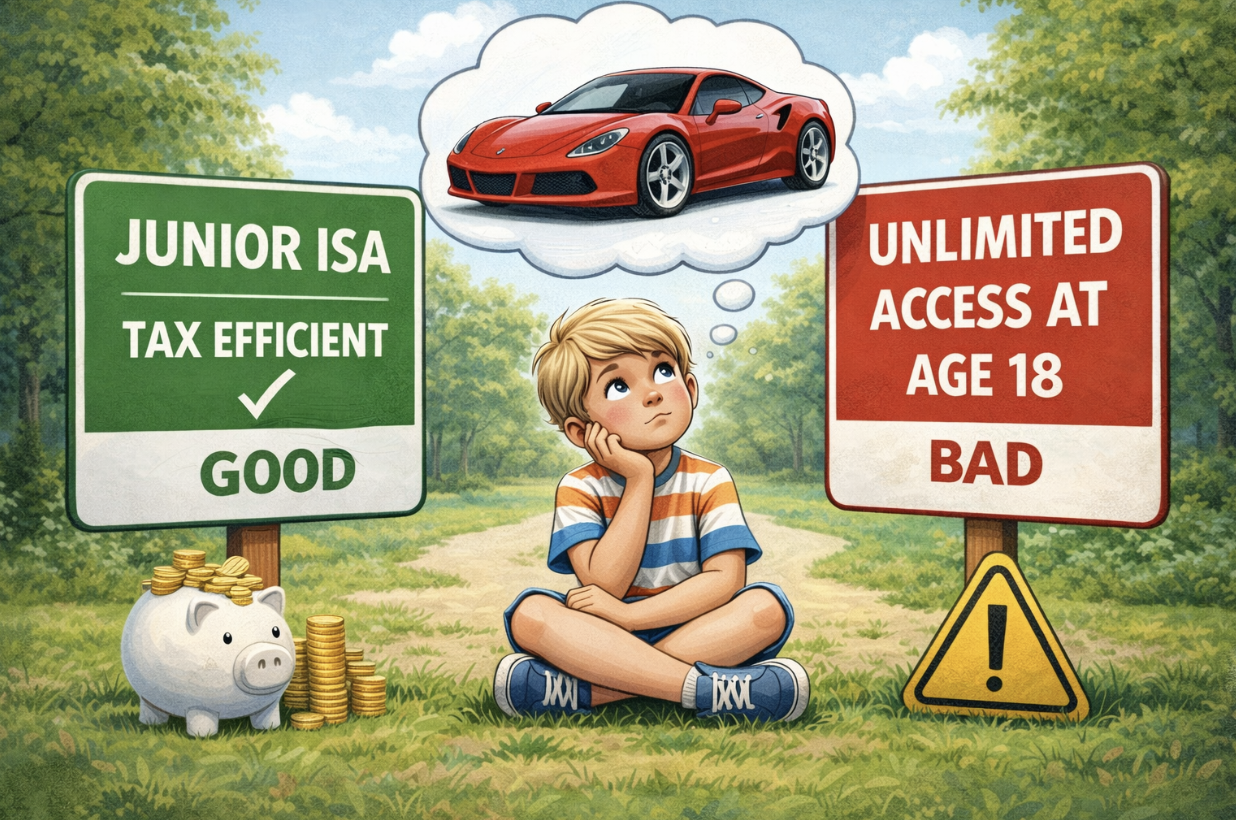
Understanding the trade-off
If you’re a parent or grandparent saving for a child, chances are Junior ISAs have come up in conversation. And for good reason – they’re one of the most tax-efficient ways to build a pot of money for a child’s future. But they come with a catch that gives a lot of families pause.
It’s a conversation I have regularly with clients, and it almost always comes down to the same question: “What if they blow it all at 18?”
In this week’s blog, we discuss the pros and cons of Junior ISAs, and put forward a potential solution for the ‘accessibility’ issue.
The Case for Junior ISAs
Here’s a recap on the current rules:
A Junior ISA (JISA) allows you to invest up to £9,000 per tax year per child.
The child must be under 18 and a UK resident at the point the account is opened.
All investment returns within the wrapper are completely tax-free - no income tax and no capital gains tax.
The funds are locked away until the child turns 18.
That final point is crucial. It enforces a long investment horizon, which is ideal for growth-focused investing. With a relatively generous annual allowance, an 18-year timeframe, and no tax drag, the compounding effect can be powerful.
For example, if you were to invest the full £9,000 each year from birth and achieve a 6% annual return (net of fees), the pot could grow to approximately £280,000 by age 18.
Adjusted for inflation at an assumed 2.5% per annum, that equates to roughly £180,000 in today’s money.
That’s a meaningful sum, likely enough to cover university costs without student debt, and fund a significant house deposit.
When investing, your capital is at risk. The value of your investment (and any income from them) can go down as well as up, and you may get back less than you invested, particularly where investing for a short timeframe (we usually recommend a horizon of at least 5 years). Neither simulated nor actual past performance is a reliable indicator of future performance. Investments should be considered over the longer term and should fit in with your overall attitude to risk and financial circumstances.
The Drawback
But that age-18 dynamic is also, arguably, the Junior ISA’s biggest weakness.
At 18, the Junior ISA automatically converts into an adult ISA, and the child – now a young adult – gains unrestricted access to the funds. No conditions. No gatekeeping. No parental override. They can contact the provider, withdraw the entire pot and spend it however they wish.
In theory, some parents might consider simply not telling their child about the JISA. In today’s world of online platforms, that might sound feasible. In practice, however, it’s difficult. Once the account converts, the provider (and any associated adviser) must engage directly with the policyholder, complete security checks and confirm the suitability of the adult ISA. Keeping it hidden is therefore unrealistic.
For many families, this unrestricted access is the sticking point. The concern isn’t always that their child will behave recklessly, but that handing a potentially life-changing sum to an 18-year-old, with no strings attached, could prove counterproductive. Could it dampen their motivation? Could it be spent impulsively rather than used as a springboard for the future? These concerns arise more often than not and are entirely understandable.
Ultimately, it’s a personal decision. Some families are comfortable trusting that strong values and open communication will prevail. Others prefer to retain control, even if that means saving outside a JISA and sacrificing some tax efficiency. Neither approach is wrong.
That said, for those wrestling with the access conundrum, there is a middle ground. It’s certainly not foolproof, but it can encourage engagement, improve financial literacy and, ideally, lead to better long-term outcomes.
A Gap Worth Filling
There’s a broader issue here that’s worth highlighting.
The UK has a well-documented financial literacy problem. A recent Santander UK study of 2,000 18–21-year-olds found that only one in four reported receiving any meaningful financial education at school. That leaves an estimated four million young people entering adulthood without a fundamental understanding of money management. [Source: Santander UK – Financial Education Report (January 2025)]
That’s a significant gap. And Junior ISAs, when used thoughtfully, can play a small but meaningful role in helping to close it.
My Preferred Approach
For what it’s worth, this is the approach I intend to take.
I have two boys, aged 4 and 6, and save regularly into their JISAs. Here’s my plan.
When they turn 15, I intend to make them aware of their JISA savings. Not just the balance, but the rationale behind it - that this money exists to help fund further education (should they choose that path), with any residual intended for a house deposit. Barring an emergency, those are the intended uses. Nothing else.
But I also want to get them interested in the world of investing. So at the same time, I plan to carve out around 5–10% of the JISA and actively involve them in the investment decision-making process. Let them choose funds, look at individual stocks, and understand risk and reward. I want them to experience the mechanics of investing first-hand - the emotions of making money, and losing it during the inevitable stock market ‘wobbles’.
The way I see it, this serves two purposes. First, it fills a gap that the school curriculum doesn’t currently cover. Second, and perhaps more importantly, it gives them a sense of ownership and understanding of the money before they have full access to it. My hope is that by the time they turn 18, they’ll see the JISA not as a windfall to spend, but as a foundation to build on.
Of course, this approach isn’t without its risks. At 18, they’ll still have unrestricted access - if one of them decides a Ferrari is a better investment than a house deposit, there’s not a great deal I can do about it. But I’d like to think that three years of conversation, education, and involvement will provide a meaningful layer of protection.
And anyway, if they do blow it all, there won’t be any more handouts. They’ll know that too.
Summary
The Junior ISA trade-off is real, and there’s no one-size-fits-all answer. But with some thought and planning, you can tilt the odds in favour of a good outcome.
If you’d like to talk through whether JISAs are right for your family, or how to structure savings for children more broadly, do get in touch.
Happy Thursday!
P.S. I’m running the London Marathon in April and raising money for Sue Ryder, a charity that provides compassionate end-of-life care and vital bereavement support for families. They help people through some of the most difficult moments in life, offering expert medical care, emotional support and practical guidance when it’s needed most. If you’d like to support this fantastic cause, I’d be hugely grateful – here’s the link to my JustGiving page: JustGiving Page.
Kind regards,
George
Referrals Welcome
Our business grows mainly through personal recommendations. If you know someone—whether a friend, family member or colleague—who might benefit from financial planning, we’d be grateful if you could share my details with them. Alternatively, you can pass their details on to me, and I’ll be happy to reach out.
Regulatory Information
Blincoe Financial Planning Limited is an appointed representative of Sense Network Ltd, which is authorised and regulated by the Financial Conduct Authority. Registered in England & Wales (No. 14569306). Registered Office: Star Lodge, Montpellier Drive, Cheltenham, GL50 1TY.
Important Disclaimer
This blog is for general information only and is intended for retail clients. It does not constitute financial or tax advice, nor is it an offer to buy or sell any specific investment. Since I don’t know your personal financial situation, you should not rely on this content as tailored advice. While we aim to provide accurate and up-to-date information, we cannot guarantee that all details remain correct over time. We are not responsible for any losses resulting from actions taken based on this blog’s content.
Start here
Wondering if we'd be a good fit?
Answer a few short questions about your situation. If it looks like we can help, you can book an introductory call with one of our planners at the end.
See if we're a good fitTwo minutes. No obligation.