
Tax Year-End Planning 2025/26: Five Key Actions Before 5 April and Major Tax Changes From April 2026
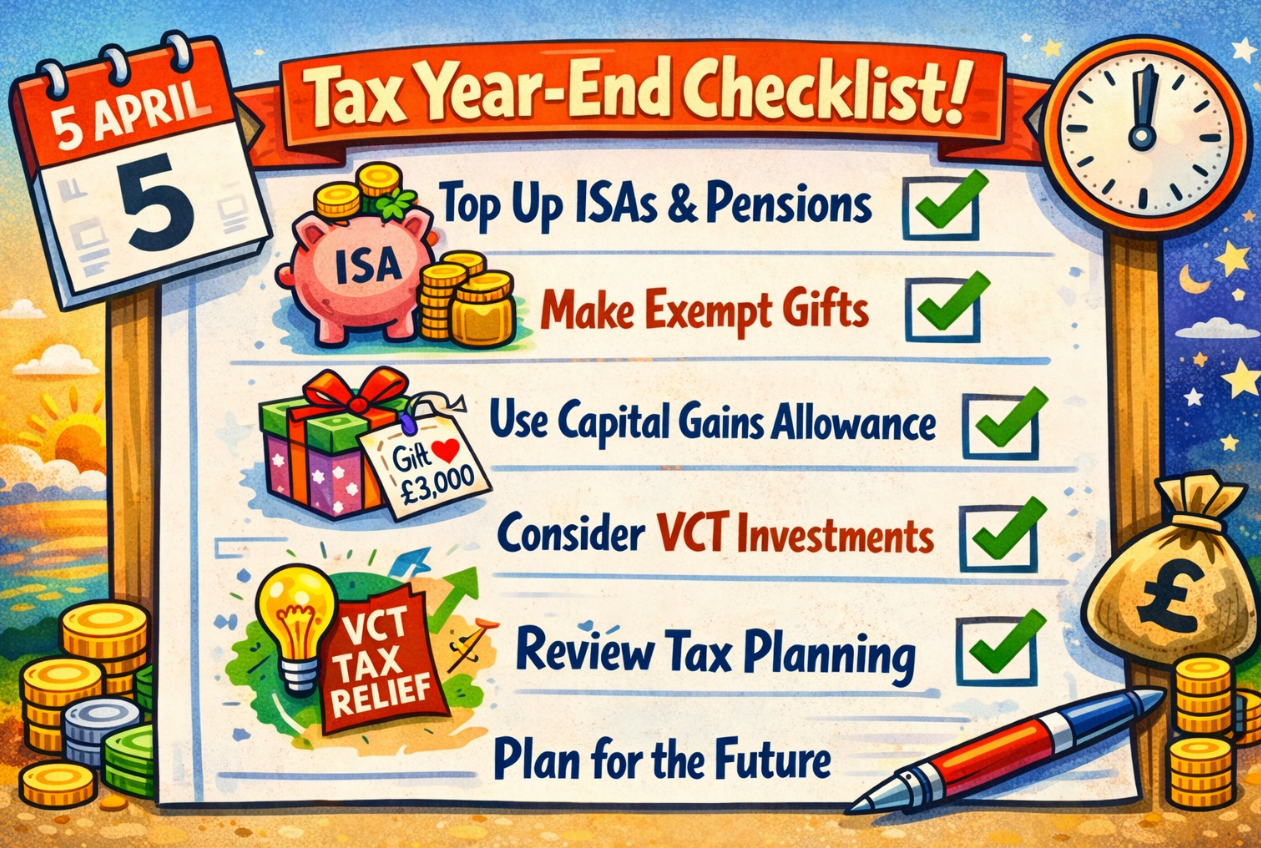
Your 2025/26 checklist — and the key tax changes coming from April 2026.
The current tax year ends in just over seven weeks (5 April 2026).
With the ongoing trend of higher taxes and frozen or reduced allowances, proactive tax planning has never been more important.
Below, we outline five key strategies to consider before the 5 April deadline, along with an overview of the significant tax changes coming into effect from the start of the new tax year.
Part 1: Tax Year-End Planning
1. ISA Allowances
ISAs remain among the simplest and most effective tax-efficient vehicles available. Interest, dividends, and investment growth within an ISA are entirely free of tax, and unlike pensions, ISA funds can be accessed at any time without penalty.
The annual ISA allowance remains at £20,000 per person for the 2025/26 tax year (£40,000 for a couple). You can distribute this across several ISA types:
Cash ISA – suited to emergency funds or short-term goals.
Stocks & Shares ISA – designed for medium to long-term investment (we typically recommend a minimum five-year horizon).
Lifetime ISA – for first-time buyers or retirement savers, with a £4,000 annual limit (forming part of the overall £20,000) and a 25% government bonus.
Junior ISA – for children under 18, with a £9,000 annual allowance.
Crucially, unused ISA allowance cannot be carried forward. It's a case of 'use it or lose it' before the deadline.
When investing, your capital is at risk. The value of your investment (and any income from them) can go down as well as up, and you may get back less than you invested. Past performance is not a reliable indicator of future performance. Investments should be considered over the longer term and should fit in with your overall attitude to risk and financial circumstances.
The Financial Conduct Authority does not regulate tax advice. Levels, bases, and reliefs from taxation may be subject to change, and their value depends on the individual circumstances of the investor.
Incoming Changes
Lifetime ISAs
Lifetime ISAs are currently under consultation and are widely expected to be withdrawn. They may be replaced with a new product aimed at first-time buyers, potentially a return to the previous ‘Help to Buy’ ISA model, where the government bonus was paid at the point of property purchase rather than on contribution.
This appears to be targeted at the growing use of LISAs as a supplementary retirement vehicle, particularly for higher earners restricted by the tapered pension annual allowance, given that LISA funds can be accessed penalty-free from age 60.
At present, there is no confirmed timeline. However, if you already hold a LISA, it may be sensible to maximise contributions before any rule changes take effect. There is also speculation that existing holders may be allowed to continue contributing under current rules, though this remains unconfirmed.
On that basis, if you are eligible and do not yet have a LISA, it may be worth opening one - even with a nominal contribution - to potentially preserve access to the current regime. That said, this remains speculative until the consultation concludes.
Cash ISAs
From April 2027, the maximum amount that under-65s can allocate to cash ISAs is due to fall to £12,000, with the remaining £8,000 directed towards stocks & shares ISAs.
This makes the current and next tax years the final opportunity to shelter the full £20,000 allowance entirely in cash, should you wish to do so.
2. Pension Contributions
Pensions remain one of the most tax-efficient planning tools available, particularly for higher and additional-rate taxpayers who benefit from upfront tax relief on contributions.
How Much Can You Contribute?
Personal contributions are limited to the lower of:
Your relevant UK earnings (work-related income); and
Your available annual allowance (normally £60,000 per tax year).
For those with adjusted income (broadly total taxable income plus employer pension contributions) above £260,000, the annual allowance is tapered by £1 for every £2 of excess income, down to a minimum of £10,000.
Non-earners can still contribute up to £3,600 gross (£2,880 net).
Unused annual allowances from the previous three tax years can also be carried forward, subject to eligibility.
Why Contribute?
We’ve noticed that some younger clients are losing confidence in pensions, particularly following repeated doom-laden media coverage ahead of potential rule changes (see below).
However, despite the noise, pensions remain one of the most effective ways to build long-term wealth, largely due to their ‘triple whammy’ tax advantages:
Pensions benefit from:
Tax relief on contributions at your marginal rate. A £1,000 gross contribution costs a basic rate taxpayer £800, a higher rate taxpayer £600 and an additional rate taxpayer £550.
Tax-free growth within the pension.
25% tax-free lump sum in retirement (up to the Lump Sum Allowance of £268,275). Note, pensions can currently be accessed from age 55, rising to 57 from 2028.
Incoming Changes
In the 2024 Autumn Statement, the Government announced plans to bring pension assets within the scope of Inheritance Tax from 6 April 2027.
Whilst this will reduce their attractiveness as an estate planning vehicle, the core benefit of pensions - building a highly tax-efficient retirement fund - remains firmly intact.
3. Realise Capital Gains
The Capital Gains Tax (CGT) annual exemption now stands at just £3,000 per person for 2025/26, following significant reductions in recent years. Combined with the higher CGT rates introduced in the October 2024 Budget (18% for basic rate taxpayers and 24% for higher rate taxpayers), careful management of taxable portfolios is increasingly important.
Where sizeable unrealised gains exist, it can make sense to crystallise up to £3,000 of gains per person before tax year-end, thereby using the available exemption.
This works particularly well alongside a ‘Bed & ISA’ or ‘Bed & Pension’ strategy - moving funds from a taxable General Investment Account into ISAs or pensions.
For example, suppose you hold a jointly owned £200,000 portfolio with an unrealised gain of £40,000. By crystallising 15% of the portfolio, you would realise a gain of £6,000 (£3,000 each), fully utilising both exemptions. This would release £30,000 of capital, which could then be redirected into ISA and/or pension contributions, thereby sheltering any future investment profits from tax.
4. Use Gifting Allowances
Inheritance Tax planning is often overlooked, yet making use of your annual gifting exemptions each year can gradually reduce the value of your taxable estate. The following gifts are immediately free of IHT (with no seven-year rule):
£3,000 per person per year (unused allowance from the previous year can be carried forward).
Small gifts of up to £250 to as many individuals as you wish (provided they haven't received part of your £3,000 exemption).
Regular gifts from surplus income provided they form part of a consistent pattern and do not affect your standard of living.
For a married couple who haven't used last year's exemption, up to £12,000 could be gifted immediately, completely free of IHT.
5. Consider VCT Investment - Last Chance for 30% Relief
For sophisticated investors with a higher risk tolerance who have already maximised ISA and pension contributions, Venture Capital Trusts (VCTs) offer attractive tax benefits.
Critically, the 2025/26 tax year is the final year in which 30% income tax relief is available - this drops to 20% from April 2026 (more on that below).
Current benefits include:
30% income tax relief on investments up to £200,000 per tax year (subject to having sufficient income tax liability).
Tax-free dividends - typically the primary source of return on underlying company exits.
Tax-free capital gains when VCT shares are sold.
VCTs invest in small, early-stage companies with high growth potential. In exchange for the generous tax incentives, you must hold the investment for at least five years to retain the initial income tax relief. We typically only recommend VCTs to investors who have already exhausted their ISA and pension allowances, earn enough to benefit from the relief, and fully understand and accept the risks involved.
We’re planning a dedicated blog on VCTs next week, recapping the key advantages and drawbacks, and outlining the forthcoming rule changes in more detail.
It’s important to note that VCTs are specialist investment vehicles and typically only suited to high net worth and experienced investors. VCTs typically invest in smaller companies that can have a higher failure rate and values can fluctuate more sharply than your mainstream investments. Furthermore, there may be difficulty in selling the investments and therefore may take some time to realise the investment. VCTs should be kept a minimum of five years to benefit from tax relief Tax rules and change along with the VCT qualifying status.
Part 2: What's Changing from April 2026 and Beyond
The 2024 and 2025 Autumn Budgets introduced a significant number of tax changes, many of which are being phased in over the coming years. Below is a summary of the key measures and when they take effect.
1. VCT Rule Changes (from 6th April 2026)
As mentioned above, income tax relief for VCT investors will fall from 30% to 20%. A £200,000 VCT subscription currently delivers up to £60,000 of income tax relief; from next year, that figure will drop to £40,000. Tax-free dividends and tax-free capital gains will continue to apply.
However, offsetting the reduction in upfront relief are some positive changes on the investment side. From April 2026:
The lifetime investment limit per company will double from £12m to £24m (£20m to £40m for 'knowledge-intensive' companies - those specialising in R&D).
VCTs will be able to invest in companies with gross assets of up to £30m at the time of investment (up from £15m).
All else being equal, these changes should allow VCTs to provide greater backing to their most promising portfolio companies and to fund more mature businesses. This could improve returns and partially compensate for the reduced tax relief. Of course, the ‘proof will be in the pudding’.
2. Business Relief Changes (from 6th April 2026)
Business Relief (BR) rules are set for a significant overhaul. Currently, qualifying business assets can receive 100% IHT relief with no upper limit, provided they have been held for at least two years at the time of death.
From April 2026:
A cap will apply: BR-qualifying assets of up to £2.5m per person (£5m per couple) will receive full 100% IHT relief (provided the two-year holding requirement is met). Any excess will attract 50% relief, producing an effective IHT rate of 20%.
Qualifying AIM-listed shares will 'only' achieve 50% IHT relief (down from the current 100%), and will not benefit from the £2.5m allowance.
It's worth noting that the £2.5m cap is a significant improvement on the original proposal of £1m per person, announced in October 2024 and subsequently revised in December 2025. The 2025 Autumn Budget also confirmed that any unused allowance will be transferable between spouses and civil partners.
An important clarification on AIM portfolios
It has been reported by some commentators that AIM portfolios can be switched into 'traditional' BR schemes before 6th April 2026 and thereby maintain the existing 100% IHT relief. This is not the case. Whilst the replacement property provisions mean the two-year clock does not restart, the new BR portfolio will only qualify for 100% IHT relief (up to the £2.5m cap) once the replacement assets have themselves been held for two years.
3. Dividend Tax Increases (from 6th April 2026)
Dividend tax rates will rise by 2 percentage points at both the basic and higher rate bands:
Basic rate: 10.75% (from 8.75%)
Higher rate: 35.75% (from 33.75%)
Additional rate: unchanged at 39.35%
The £500 dividend allowance remains unchanged.
This is a particular sting for owner-managers of limited companies who typically remunerate themselves with a modest salary (to maintain State Pension credits) and draw the balance as dividends. For example, someone drawing a salary of £12,570 and dividends of approximately £88,000 - thereby keeping overall taxable income just below the £100,000 threshold to avoid 60% marginal rate tax - can expect an increase in their annual tax bill of around £1,760 under the new rates.
For investors, this further underscores the importance of utilising ISA allowances each year, where any subsequent dividend income is received tax-free.
4. Making Tax Digital for Income Tax (from 6th April 2026)
Making Tax Digital (MTD) for Income Tax is arguably the most significant administrative change in the UK tax system for a generation. It replaces the traditional annual Self Assessment tax return with a requirement to keep digital records and submit quarterly updates to HMRC throughout the year.
The rollout is being phased in based on qualifying income (combined gross income from self-employment and property, before expenses):
From April 2026: those with qualifying income above £50,000 (based on the 2024/25 tax year).
From April 2027: the threshold drops to £30,000.
From April 2028: the Government plans to lower the threshold further to £20,000.
Affected individuals are primarily sole traders and landlords, who will need to use HMRC-recognised software to maintain digital records and submit quarterly summaries of income and expenses. Importantly, these are not additional tax returns; the annual Self Assessment return (or its equivalent 'final declaration') will continue alongside the quarterly updates.
On a positive note, HMRC has confirmed that those joining MTD in April 2026 will not incur penalty points for late quarterly updates during the first 12 months, providing a 'soft landing' period to adjust.
If you are a sole trader or landlord, we strongly recommend reviewing the guidance on GOV.UK, and speaking with your accountant or tax adviser to ensure you are prepared.
Further Changes on the Horizon
In addition to the changes taking effect this April, several further measures have been announced but are not due to come into force immediately:
Pensions and IHT (April 2027): unused pension funds will be included within a person's estate for Inheritance Tax purposes. This was announced in the 2024 Autumn Statement.
Income tax on rental profits (April 2027): property income tax rates will rise by 2 percentage points across all bands (to 22%, 42%, and 47%).
Savings income tax (April 2027): savings income tax rates will also rise by 2 percentage points (to 22%, 42%, and 47%).
Cash ISA allowance reduction (April 2027): the cash ISA limit for those under 65 will be reduced from £20,000 to £12,000, with the remaining £8,000 of allowance needing to be directed towards investment ISAs.
High Value Council Tax Surcharge / 'Mansion Tax' (April 2028): an annual surcharge of £2,500 on properties worth more than £2m, rising (in increments) to £7,500 for properties above £5m.
Salary sacrifice NI cap (April 2029): the NI exemption on salary sacrifice pension contributions will be limited to the first £2,000 per year. Contributions above this threshold will be subject to both employer and employee National Insurance.
Conclusion
Whilst tax should never be the sole driver of investment decisions - ‘don’t let the tax tail wag the investment dog’ as they say - taking advantage of the allowances and reliefs available before the 5th April deadline can deliver meaningful long-term benefits. With significant changes on the horizon, advance planning is more important than ever.
If you'd like to discuss any of these strategies in more detail, please don't hesitate to get in touch.
Happy Thursday!
Kind regards,
George
George Taylor, CFA
Referrals Welcome
Our business grows mainly through personal recommendations. If you know someone—whether a friend, family member or colleague—who might benefit from financial planning, we’d be grateful if you could share my details with them. Alternatively, you can pass their details on to me, and I’ll be happy to reach out.
Regulatory Information
Blincoe Financial Planning Limited is an appointed representative of Sense Network Ltd, which is authorised and regulated by the Financial Conduct Authority. Registered in England & Wales (No. 14569306). Registered Office: Star Lodge, Montpellier Drive, Cheltenham, GL50 1TY.
Important Disclaimer
This blog is for general information only and is intended for retail clients. It does not constitute financial or tax advice, nor is it an offer to buy or sell any specific investment. Since I don’t know your personal financial situation, you should not rely on this content as tailored advice. While we aim to provide accurate and up-to-date information, we cannot guarantee that all details remain correct over time. We are not responsible for any losses resulting from actions taken based on this blog’s content.
Start here
Wondering if we'd be a good fit?
Answer a few short questions about your situation. If it looks like we can help, you can book an introductory call with one of our planners at the end.
See if we're a good fitTwo minutes. No obligation.